


Why are double telecentric lenses essential for precision measurement? Analysis of 5 core advantages
In the wave of smart manufacturing, precision measurement has become a core component of industrial production. From nanometer-level line width detection in electronic chips to millimeter-level dimensional calibration in automotive components, measurement accuracy directly impacts product quality and production efficiency. Dual telecentric lenses, with their unique optical design, have become the “gold standard” in high-precision industrial inspection.
Advantage 1: Ignores height differences
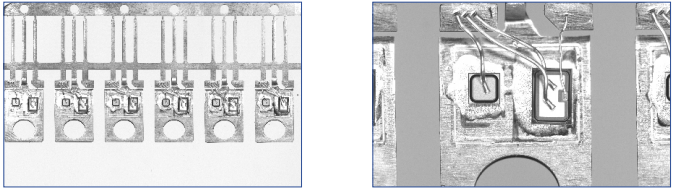
Traditional industrial lenses follow the perspective principle of “near large, far small.” When the object being measured has height differences or an uneven surface, the image size will vary with the object distance, resulting in errors. For example, when inspecting circuit boards, if there is a 0.1 mm height difference between a surface-mounted capacitor and an adjacent solder point, the image size of a conventional lens may deviate by more than 5%, leading to incorrect size judgments.
Dual telecentric lenses utilize a dual-sided telecentric optical path design, aligning both the object-side and image-side principal rays parallel to the optical axis, thereby completely eliminating the influence of object distance changes on imaging. Experimental data shows that within a ±5mm depth of field range, the imaging size deviation of a dual telecentric lens for an object with a height difference of 0.5mm is less than 0.001mm, representing an improvement in precision of over 20 times compared to traditional lenses. This characteristic makes it an ideal tool for inspecting objects with stepped structures or curved surfaces (such as watch cases or smartphone frames).
Advantage 2: Ultra-low distortion
Distortion is a core metric for evaluating the accuracy of lens imaging. The distortion rate of ordinary industrial lenses typically ranges between 1% and 2%, meaning that when inspecting an object 50mm wide, the imaging error could reach 1mm. In contrast, dual telecentric lenses achieve a distortion rate below 0.1% through precise aperture control and optimized optical materials.
Take watch inspection as an example: the width of the watch dial's scale lines is only 0.02mm. Traditional lenses may cause the edges of the scale lines to appear blurred or curved due to distortion, whereas telecentric lenses can clearly display straight edges, ensuring the inspection system can accurately identify dimensional deviations as small as 0.001mm. This “molecular-level” precision is precisely why telecentric lenses are indispensable in fields such as semiconductors and precision machinery.
Advantage 3: Large depth of field and high resolution
Precision measurement often faces the contradiction of “needing to see both broadly and clearly.” Traditional lenses often sacrifice depth of field in pursuit of high resolution; however, dual telecentric lenses achieve both high resolution and a large depth of field through parallel optical path design. For example, when inspecting a smartphone touchscreen, a dual telecentric lens can simultaneously capture clear images of a 0.1mm-thick glass substrate and a 0.5mm-high raised button within a 10mm depth of field range, without the need for repeated focusing adjustments.
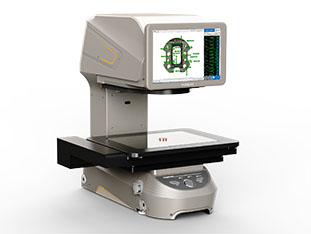
This feature is particularly critical in flash measurement instruments (one-button measurement devices). When paired with a high-resolution camera, dual telecentric lenses can capture the entire workpiece image in a single shot, enabling software to automatically extract hundreds of dimensional parameters, thereby enhancing measurement efficiency.
Advantage 4: Strong anti-interference capability
Industrial environments are subject to interference factors such as vibration, dust, and uneven lighting, which can cause traditional lenses to produce blurry images or measurement fluctuations due to environmental changes. Dual telecentric lenses effectively resist external interference through their closed optical structure and coaxial light source design:
1. Closed design: The lens interior uses a sealed structure to prevent dust from entering the optical system, ensuring that resolution does not deteriorate over long-term use
2. Coaxial light source compatibility: Compatible with ring-shaped LED light sources to eliminate reflective interference and enhance detection contrast for transparent materials (e.g., watch glass, LCD panels);
3. Temperature stability: Utilizes materials with low thermal expansion coefficients, ensuring image size changes of less than 0.001 mm/°C within the temperature range of -20°C to 60°C, meeting the high-temperature environment detection requirements of automotive electronics and other applications.
Advantage 5: Full scene adaptation from micro to macro
The advantages of double telecentric lenses are not only reflected in a single parameter, but also in their cross-scenario versatility:
1. Microscopic inspection: Zoom design ranging from 0.1X to 0.7X, capable of inspecting chip pin pitch (0.3mm level) and MEMS sensor microstructures (0.01mm level);
2. Macro Inspection: Wide-field models can cover workpieces up to 1 meter in size, such as automotive sheet metal parts and large molds for dimensional calibration;
3. Dynamic Inspection: When paired with a high-speed camera, it can monitor real-time changes in workpiece dimensions on the production line, with a response time as fast as milliseconds.
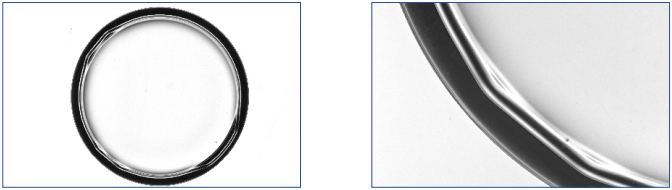
Take watch inspection as an example. A 0.16X low-magnification lens can quickly capture the entire image of the watch face to inspect the integrity of the scale and the installation position of the hands. A 0.7X high-magnification lens focuses on specific areas to inspect microstructures such as the diameter of the jewel bearing hole and the pitch of the gears. This combination of “macro + micro” inspection modes improves inspection efficiency.
Product recommendation
TECHNICAL SOLUTION
MORE+You may also be interested in the following information
FREE CONSULTING SERVICE
Let’s help you to find the right solution for your project!
 ASK POMEAS
  PRICE INQUIRY
  REQUEST DEMO/TEST
  FREE TRIAL UNIT
  ACCURATE SELECTION
- APPICATION CASE
- RESOURCE CENTER
- DOWNLOAD CENTER
SOLUTIONS SUPPORT
- ZOOM LENS SELECTION TOOL
- TELECENTRIC LENS SELECTION TOOL
- FA LENS SELECTION TOOL
- ZOOM RATIO TABLE
- CERTIFIED MODEL
SELECTION TOOL
- WHY POMEAS
- FAQ
- PRIVACY POLICY
- TERMS OF USE
- DELIVERY & RETURN POLICY
CUSTOMER CARE
 ADDRESS
Add.:No.68, Yongwei Road, Baizhoubian, Dongcheng District, Dongguan, China,523000
CONTACT
 Tel:+ 86-0769-2266 0867
 Fax:+ 86-0769-2266 0867
 E-mail:marketing@pomeas.com

Wechat QR code

Software Copyright :2021SR0176001 抄袭必究, 技术支持:誉新源科技