


How to calculate the focal length and working distance required for industrial lenses?
In industrial vision systems, the lens serves as the core imaging component. The selection of its focal length and working distance directly determines imaging quality, detection range, and system accuracy. For engineers, the precise calculation of these two parameters is a fundamental prerequisite for achieving vision inspection objectives.
I. First, clarify core concepts: Avoid selection cognitive biases
Before performing calculations, it is essential to clearly define three closely related core parameters. These form the foundation for subsequent computations and are critical for avoiding selection errors:
1. Focal Length (f): The distance from the optical center of the lens to the imaging plane (the light-sensitive surface of the camera sensor). This is the primary metric for measuring light convergence or divergence. A shorter focal length yields a wider field of view, capturing a broader scene; a longer focal length narrows the field of view, enabling magnification of distant objects. Common focal length specifications for industrial lenses include 8mm, 12mm, 16mm, 25mm, and 50mm.
2. Working Distance (WD): Also known as the object distance, this denotes the physical distance from the lens's front element to the surface of the object being measured. Most industrial lenses offer adjustable working distances, while specialized lenses like telecentric lenses have fixed working distance requirements.
3. Field of View (FOV): This denotes the maximum area of the object that can be clearly imaged at a specific working distance, typically expressed in horizontal (H) and vertical (V) dimensions. When selecting a lens, ensure the FOV slightly exceeds the object's dimensions to fully cover the inspection area.
Additionally, the camera sensor's image sensor size (i.e., the physical dimensions of the sensor, such as a 1/2-inch sensor corresponding to 6.4mm horizontally and 4.8mm vertically) is a critical prerequisite for calculation—the lens image must fully cover the image sensor. Otherwise, vignetting will occur at the edges, affecting detection performance.
II. Fundamental Proportional Relationships: Core Formula
Under ideal imaging conditions, the lens, the object being measured, and the sensor form a similar triangle, resulting in the following core proportional relationship:
Working Distance (WD) / Field of View (FOV) = Focal Length (f) / Sensor Size (corresponding direction)
This relationship serves as the foundation for all calculations and can be adapted into various formulae based on specific requirements. It is applicable to the selection calculations for the vast majority of industrial fixed-focus lenses (FA lenses).
III. Calculation Considerations: Key Details for Mitigating Selection Risks
1. Lens image circle matching with camera sensor: Select lenses with an image circle size equal to or larger than the camera sensor's diagonal dimension to prevent vignetting. For high-quality edge imaging, opt for lenses with one size larger image circles.
2. Minimum Focus Distance Restriction: Each lens has a “minimum focus distance” (the shortest working distance at which clear imaging is possible). The calculated working distance must exceed this value; otherwise, sharp focus cannot be achieved. It is strictly prohibited to shorten the working distance by adding extension tubes, as this disrupts the optical structure balance and degrades imaging quality.
3. Depth of Field Requirements: For objects with height variations (e.g., three-dimensional parts), sufficient depth of field (the range of object heights that can be sharply imaged) must be maintained. Generally, smaller apertures, longer working distances, and shorter focal lengths increase depth of field. Adjust parameters based on inspection needs.
4. Adapting to Standardized Focal Lengths: Calculated focal lengths may yield non-standard values (e.g., 28.4mm). Select the closest standard specification, then revalidate whether the field of view and working distance meet requirements. Fine-tune the installation position if necessary.
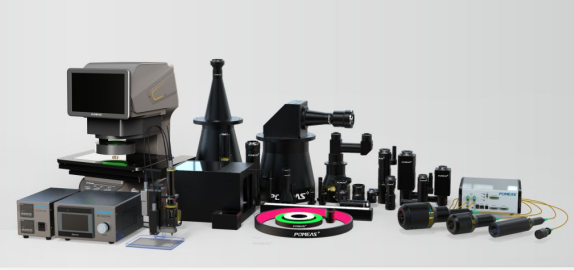

If you encounter calculation challenges or have questions about your requirements during the selection process for industrial lenses or cameras, feel free to contact POMEAS at any time. Our professional engineers will provide you with customized solutions.
Product recommendation
TECHNICAL SOLUTION
MORE+You may also be interested in the following information
FREE CONSULTING SERVICE
Let’s help you to find the right solution for your project!
 ASK POMEAS
  PRICE INQUIRY
  REQUEST DEMO/TEST
  FREE TRIAL UNIT
  ACCURATE SELECTION
- APPICATION CASE
- RESOURCE CENTER
- DOWNLOAD CENTER
SOLUTIONS SUPPORT
- ZOOM LENS SELECTION TOOL
- TELECENTRIC LENS SELECTION TOOL
- FA LENS SELECTION TOOL
- ZOOM RATIO TABLE
- CERTIFIED MODEL
SELECTION TOOL
- WHY POMEAS
- FAQ
- PRIVACY POLICY
- TERMS OF USE
- DELIVERY & RETURN POLICY
CUSTOMER CARE
 ADDRESS
Add.:No.68, Chongwei Road, Baizhoubian, East district, Dongguan, China, 523000
CONTACT
 Tel:+ 86-0769-2266 0867
 Fax:+ 86-0769-2266 0867
 E-mail:marketing@pomeas.com

Wechat QR code

Software Copyright :2021SR0176001 抄袭必究, 技术支持:誉新源科技