


Comparison of High-Precision Image Measuring Instruments and Laser Scanners
In the field of precision manufacturing, contour dimension measurement is a core process for ensuring products meet design specifications. Taking the rear cover plate of a mobile phone as an example, parameters such as its curved surface radius, R corners, and hole positioning accuracy directly impact the overall assembly quality and user experience. High-precision image measuring instruments and laser scanners, as two mainstream non-contact measurement technologies, are progressively becoming the primary tools for precision inspection.

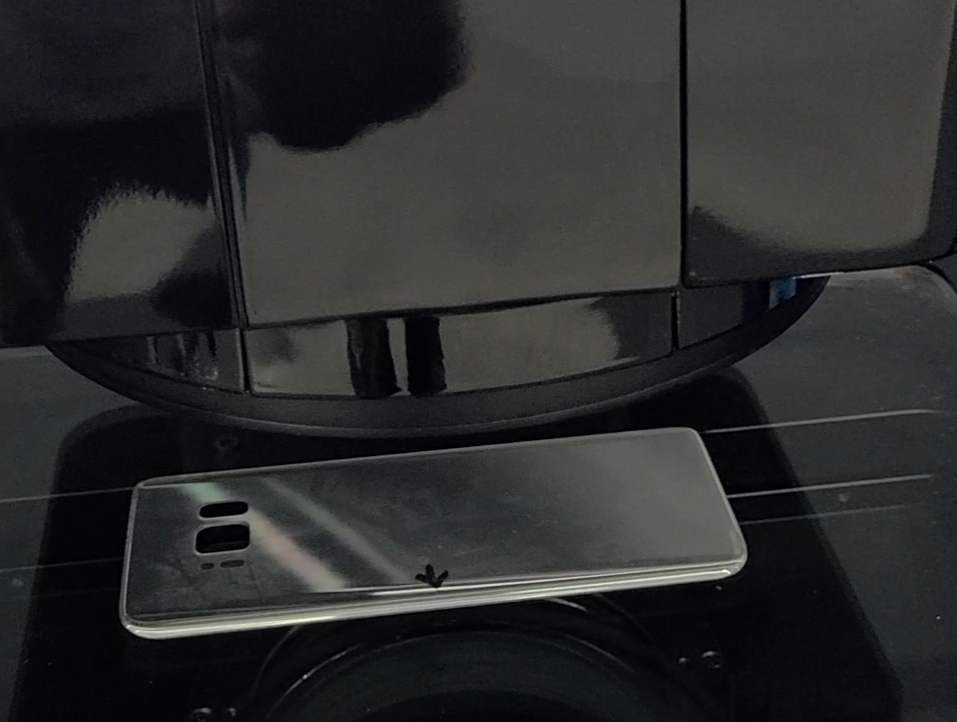
I. Comparison of Technical Principles and Core Advantages
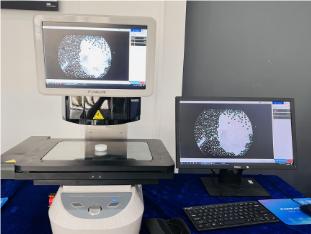
1. The high-precision image measuring instrument captures images of the object under test using a high-resolution industrial camera. Combined with telecentric optical lenses and image analysis algorithms, it enables automated measurement of parameters such as dimensions, shape, and position. Its core advantages lie in:

-
Full-Dimensional Measurement Capability: Simultaneously captures multiple parameters including length, width, curvature, R corners, and aperture without sequential operations. Taking POMEAS IMAGE3 max as an example, its dual telecentric lenses feature distortion rates below 0.1%. Paired with a 5-megapixel industrial camera, it clearly captures features as fine as 0.01mm. A single measurement covers 512 points, achieving over 10 times the efficiency of traditional projectors.
-
Non-contact measurement: Prevents deformation or damage caused by physical contact, making it ideal for inspecting brittle materials (e.g., glass back covers) or complex surfaces (e.g., 3D curved back covers).
-
Intelligent operation: Supports CAD drawing import and automatic template matching, eliminating manual measurement point positioning. For instance, when measuring smartphone back covers, IMAGE3 max automatically identifies contours and critical hole positions with positioning accuracy of ±0.005mm. Operators simply place the product and press the start button to complete the entire inspection process.
-
Environmental Adaptability: Featuring a compact structure with no moving parts, it offers high stability and can be deployed alongside production lines for “line-side inspection,” reducing logistics time and the risk of secondary damage.
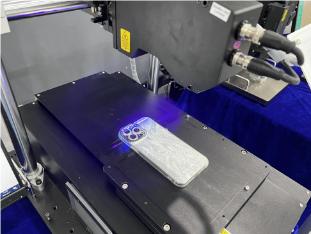
2. Laser scanners capture three-dimensional coordinate data of object surfaces by emitting laser beams and calculating the time difference of reflected light, making them suitable for dynamic or large-scale contour measurements. Their core advantages include:

-
High Frequency and High Precision: Capable of capturing tens of thousands of point cloud data points per second, ideal for inspecting moving objects (e.g., wheel treads) or complex surfaces (e.g., track profiles). For instance, the ZhenShang ZLDS200 2D laser scanner rapidly measures entire profiles rather than limited points, comprehensively reflecting surface contour conditions.
-
Long-Range Measurement Capability: Laser scanners typically operate at reading distances exceeding 30 cm, extending up to several meters, making them suitable for scenarios like warehouse logistics and large-scale workpiece inspection.
-
Transparent Measurement: Capable of reading barcodes through glass or transparent adhesive tape, or detecting partially obscured contours (e.g., embedded structural components).
II. Comparison of Technical Limitations
1. Limitations of High-Precision Image Measuring Instruments
- Depth-of-Field Limitations: Telecentric lenses are sensitive to changes in object distance, requiring a constant distance between the workpiece and the lens to prevent measurement errors caused by defocusing. However, the POMEAS IMAGE3 max effectively mitigates this issue through its dual telecentric design, ensuring parallel light paths between the object side and the image side.
- Environmental Sensitivity: Camera performance may degrade in high-temperature, high-humidity, or strong magnetic field environments, impacting image quality and measurement accuracy.
- Functional Limitations: Primarily focused on dimensional and geometric measurement, lacking the multifunctional integration capabilities of laser scanners (e.g., barcode recognition, material analysis).
2. Limitations of Laser Scanners
- Point cloud data processing complexity: Massive datasets require filtering, fitting, and reconstruction through specialized software, demanding substantial computational resources and potentially leading to feature loss due to algorithmic limitations.
- Surface reflectivity impact: Highly reflective or transparent materials (e.g., metal back covers) may cause laser scattering, necessitating the application of contrast agents or scanning parameter adjustments, thereby increasing operational complexity.
- Higher cost: High-end laser scanners typically cost 2-3 times more than image measurement devices, with additional maintenance expenses.
III. Typical Examples
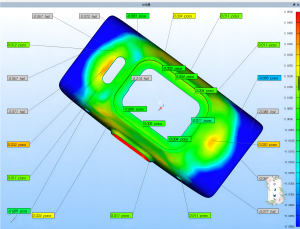

Taking the phone back cover as an example, its testing requirements include:
- Base Dimensions: Length, width, and thickness must maintain assembly tolerances within ±0.02mm relative to the midframe;
- Curved Surface Characteristics: Radius of curvature and surface height influence grip comfort;
- Detailed Features: Edge radius (typically R1-R3mm), camera aperture/charging port aperture size and positional accuracy require precise control.
1. Applications of the High-Precision Image Measuring Instrument (POMEAS IMAGE3 max)
- Measurement Process: Place the rear cover plate arbitrarily on the stage → The system automatically identifies the contour and hole positions → The algorithm simultaneously calculates parameters such as length, width, curvature, and R corners → Outputs measurement results and tolerance judgment (pass/fail) within 2-3 seconds.
- Demonstration of Advantages:
- Comprehensive Coverage: Obtain all critical parameters in a single measurement, eliminating efficiency losses from step-by-step operations.
- High Repeatability: Pixel-based measurement scales remain unaffected by temperature and humidity, delivering superior long-term stability compared to laser scanners.
- Flexible Adaptability: Supports rapid switching between measurement programs for multiple rear cover plate models without hardware adjustments, accommodating small-batch, multi-variety production modes.
2. Application Challenges of Laser Scanners
-
Data redundancy: Scanning tens of thousands of point cloud data points is required to cover the rear cover surface, followed by subsequent processing to remove invalid points and fit characteristic curves, resulting in significant time consumption.
-
Accuracy fluctuations: Highly reflective metal surfaces may cause laser scattering, necessitating multiple scans to calculate averages and increasing measurement uncertainty.
-
Cost-benefit imbalance: For low-volume production batches of smartphone rear covers, the high investment and complex operation of laser scanners fail to demonstrate cost-effectiveness advantages.
High-precision image measuring instruments and laser scanners each have distinct strengths in contour dimension measurement: image measuring instruments are better suited for small-range, high-precision, batch static measurements; laser scanners excel at dynamic, large-range, or complex-environment contour detection.
Product recommendation
TECHNICAL SOLUTION
MORE+You may also be interested in the following information
FREE CONSULTING SERVICE
Let’s help you to find the right solution for your project!
 ASK POMEAS
  PRICE INQUIRY
  REQUEST DEMO/TEST
  FREE TRIAL UNIT
  ACCURATE SELECTION
- APPICATION CASE
- RESOURCE CENTER
- DOWNLOAD CENTER
SOLUTIONS SUPPORT
- ZOOM LENS SELECTION TOOL
- TELECENTRIC LENS SELECTION TOOL
- FA LENS SELECTION TOOL
- ZOOM RATIO TABLE
- CERTIFIED MODEL
SELECTION TOOL
- WHY POMEAS
- FAQ
- PRIVACY POLICY
- TERMS OF USE
- DELIVERY & RETURN POLICY
CUSTOMER CARE
 ADDRESS
Add.:No.68, Chongwei Road, Baizhoubian, East district, Dongguan, China, 523000
CONTACT
 Tel:+ 86-0769-2266 0867
 Fax:+ 86-0769-2266 0867
 E-mail:marketing@pomeas.com

Wechat QR code

Software Copyright :2021SR0176001 抄袭必究, 技术支持:誉新源科技