


In the field of industrial manufacturing, image-based dimensional measurement systems have become essential equipment for ensuring product quality and improving production efficiency. Whether in the hardware, plastics, rubber, or medical industries, precise dimensional measurement is a core component of quality control. However, with such a wide variety of measurement instruments available on the market, how can you choose an image-based dimensional measurement system that truly meets your specific needs?

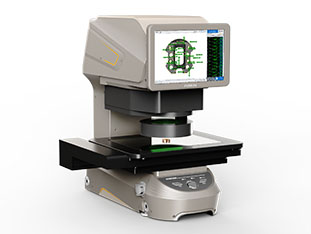
I. Define Measurement Requirements and Pinpoint Targets

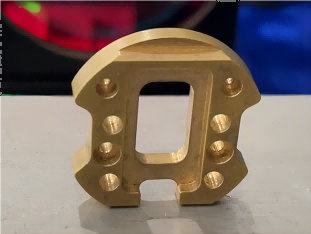
1. Characteristics of the Measurement Object
First, it is necessary to clarify the size range, geometric complexity, and material properties of the measurement object. Different materials exhibit varying characteristics of light reflection and absorption, which directly influence the selection of measurement methods. For example, transparent materials require the use of ray measurement technology, while reflective metal surfaces require a coaxial light source to eliminate reflection interference.
2. Accuracy and Efficiency Requirements
Determine the accuracy grade based on product tolerance requirements. Precision electronic components require sub-micron accuracy (≤1 μm), whereas mechanical parts may allow for an error of 3–5 μm. At the same time, measurement efficiency must be evaluated; for instance, if 100 SMT components need to be inspected per hour, equipment capable of high-speed measurement must be selected.
II. Comparison of Key Specifications: Making an Informed Selection

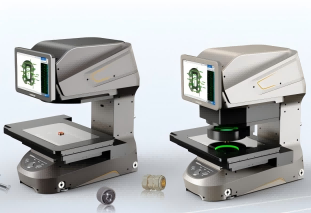
1. Measurement Accuracy and Resolution
- Optical resolution: Determined jointly by the lens and sensor, it must be greater than 1/10 of the smallest dimension of the feature being measured. For example, to measure a 0.1 mm micro-hole, a lens with a resolution of ≤0.01 mm is required.
- Digital resolution: Calculated by combining the field of view with the sensor resolution. For example, with a 10mm × 10mm field of view and a 2000 × 2000-pixel sensor, the effective resolution reaches 5 μm per pixel.
- Accuracy grade: High-end equipment such as the POMEAS IMAGE 3 MAX2 can achieve high-precision measurements of ±0.1 μm, making it suitable for precision applications such as semiconductor wafer inspection.
2. Field of View and Magnification
- Wide-field mode (e.g., 300 mm × 200 mm): Ideal for batch measurement of standard parts, capable of covering multiple workpieces in a single scan.
- Small-field high-precision mode (e.g., 10 mm × 10 mm): When used with a 10X fixed-magnification lens, this mode enables micron-level local measurements.
- Continuously variable ZOOM LENS (0.7X–4.5X): Flexibly adapts to workpieces of different sizes, reducing the frequency of lens changes.
3. Lighting System Configuration
- Ring Light: Eliminates shadows on flat workpieces; ideal for measuring the contours of metal parts.
- Coaxial Light: Suppresses specular reflections; suitable for highly reflective surfaces such as smartphone glass covers.
- Backlight: Highlights the edges of transparent materials, such as for inspecting the graduations on medical syringes.
- Adjustable-Angle Light: Suitable for curved workpieces, such as for measuring the three-dimensional topography of automotive interior components.
III. Functional Scalability and Forward-Looking Planning
1. Automation and Intelligence
- One-click measurement: Using POMEAS AI vision technology, this feature enables automatic positioning, lighting, and focusing, eliminating human error.
- Batch processing capability: The POMEAS Image3 series supports CNC mode, allowing for the measurement of hundreds of parts in a single operation, thereby improving efficiency.
- CAD comparison: Directly import DXF/STEP drawings to automatically match design data with actual measurement results.
2. Interfaces and Compatibility
- Data Transfer Interfaces: USB 3.0 and GigE enable high-speed data transfer, while Gigabit Ethernet supports remote control.
- Software Compatibility: Compatible with statistical software such as Minitab, enabling the direct generation of CPK analysis reports.
- Environmental Requirements: The semiconductor industry requires an ISO Class 5 cleanroom, and high-precision equipment must be equipped with an air-bearing vibration isolation table.
IV. Brand and Service: Long-Term Assurance


1. Manufacturer's Capabilities
- Technical Expertise: Choose manufacturers with over 10 years of experience in the field of imaging measurement, such as POMEAS’s proprietary i-Vision AI vision technology.
- Core Components: Pay close attention to the sources of key components such as CCD sensors and linear encoders; imported components typically offer superior stability.
2. After-Sales Service System
- Response Time: Give priority to vendors that offer 24/7 online technical support.
- Maintenance Costs: Be aware of hidden costs such as annual calibration fees and replacement cycles for wear-and-tear parts.
- Software Updates: Confirm whether the vendor provides free algorithm updates.
Product recommendation
TECHNICAL SOLUTION
MORE+You may also be interested in the following information
FREE CONSULTING SERVICE
Let’s help you to find the right solution for your project!
 ASK POMEAS
  PRICE INQUIRY
  REQUEST DEMO/TEST
  FREE TRIAL UNIT
  ACCURATE SELECTION
- APPICATION CASE
- RESOURCE CENTER
- DOWNLOAD CENTER
SOLUTIONS SUPPORT
- ZOOM LENS SELECTION TOOL
- TELECENTRIC LENS SELECTION TOOL
- FA LENS SELECTION TOOL
- ZOOM RATIO TABLE
- CERTIFIED MODEL
SELECTION TOOL
- WHY POMEAS
- FAQ
- PRIVACY POLICY
- TERMS OF USE
- DELIVERY & RETURN POLICY
CUSTOMER CARE
 ADDRESS
Add.:No.68, Chongwei Road, Baizhoubian, East district, Dongguan, China, 523000
CONTACT
 Tel:+ 86-0769-2266 0867
 Fax:+ 86-0769-2266 0867
 E-mail:marketing@pomeas.com

Wechat QR code

Software Copyright :2021SR0176001 抄袭必究, 技术支持:誉新源科技