


How Image Dimension Measurement Instruments Ensure Connector Quality
In the consumer electronics industry, connectors serve as the “bridge” that ensures uninterrupted signal transmission and stable device operation. The dimensions of the densely packed pins (contact terminals) inside—including width, pitch, coplanarity, and positional accuracy—must all be maintained within extremely tight tolerances; even the slightest deviation can lead to poor contact, signal interruption, or even product failure. A well-known connector manufacturer once faced precisely this kind of quality control challenge.

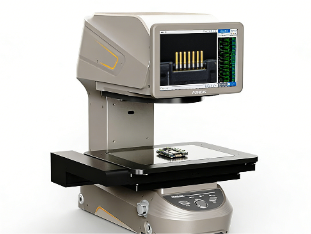
Challenge: When it comes to miniature board-to-board connectors, which feature up to 40 pins, there are stringent requirements regarding the width of each pin, the spacing between adjacent pins, and the coplanarity of the entire row of pins. Previously, manual inspection was performed under a tool microscope, with each connector requiring nearly 15 minutes of work by a skilled operator. This process was not only inefficient but also caused significant eye strain for employees, leading to persistently high rates of missed defects and misjudgments. During production ramp-up phases, this became a delivery bottleneck, and the risk of customer complaints remained constant.
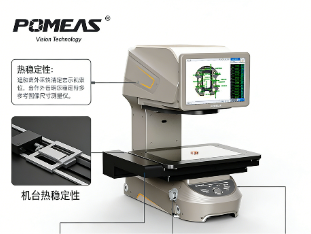
Solution: After conducting an evaluation, they implemented a fully automated image dimension measurement system, such as the Promis image dimension measurement system. The specific implementation steps are as follows:

-
Programming Phase: Technicians use the device’s “teach-in” programming software to plan the measurement path for the first standard sample. The software provides clear imaging through a high-magnification lens; technicians simply need to select the left and right edges of the first pin to be measured on the screen. The software then automatically learns the features and, using the “array copy” or “pattern recognition” functions, generates measurement programs for the width and spacing of all 40 pins with a single click. Coplanarity measurement is achieved through laser or high-precision focused surface scanning capabilities.
-
Automated Inspection: Once the program is complete, the operator simply places the connector into a dedicated fixture (or loads it automatically via a vibrating feeder) and clicks “Start.” The equipment’s worktable moves automatically, and a high-definition camera sequentially positions itself over each pin, automatically focusing, capturing images, performing edge analysis, calculating dimensions, and comparing them in real-time against preset tolerances.
-
Data and Results: The entire measurement process is completed within 2 minutes. Upon completion, the software interface immediately displays the results for each dimension in a color-coded format (green for pass, red for out-of-tolerance) and automatically generates a detailed inspection report containing measured values, deviations, CPK, and other data.
Results:
-
A Leap in Efficiency: Inspection time per unit has been reduced from 15 minutes to 2 minutes, representing a more than sevenfold increase in efficiency, making it easy to handle high-volume production.
-
Zero-Defect Quality: 100% full inspection has been achieved, completely eliminating manual inspection oversights. This has significantly improved the consistency of outgoing product quality and led to a marked decrease in customer complaints.
-
Data-Driven Management: All measurement data is stored electronically, facilitating long-term quality trend analysis (SPC) and providing precise data support for process optimization.
-
Workforce Liberation: Employees are freed from tedious, repetitive microscopic inspections and can focus on higher-value tasks such as equipment operation and data analysis.
Product recommendation
TECHNICAL SOLUTION
MORE+You may also be interested in the following information
FREE CONSULTING SERVICE
Let’s help you to find the right solution for your project!
 ASK POMEAS
  PRICE INQUIRY
  REQUEST DEMO/TEST
  FREE TRIAL UNIT
  ACCURATE SELECTION
- APPICATION CASE
- RESOURCE CENTER
- DOWNLOAD CENTER
SOLUTIONS SUPPORT
- ZOOM LENS SELECTION TOOL
- TELECENTRIC LENS SELECTION TOOL
- FA LENS SELECTION TOOL
- ZOOM RATIO TABLE
- CERTIFIED MODEL
SELECTION TOOL
- WHY POMEAS
- FAQ
- PRIVACY POLICY
- TERMS OF USE
- DELIVERY & RETURN POLICY
CUSTOMER CARE
 ADDRESS
Add.:No.68, Chongwei Road, Baizhoubian, East district, Dongguan, China, 523000
CONTACT
 Tel:+ 86-0769-2266 0867
 Fax:+ 86-0769-2266 0867
 E-mail:marketing@pomeas.com

Wechat QR code

Software Copyright :2021SR0176001 抄袭必究, 技术支持:誉新源科技