


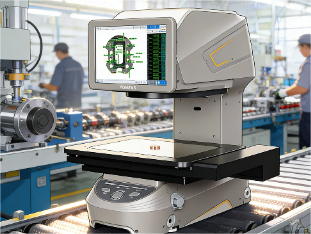
Traditional precision measuring instruments are often perceived as “delicate” and require installation in metrology laboratories with controlled temperature, humidity, and dust-free conditions. However, the demand for inspection efficiency in modern manufacturing is driving measurement technology to move forward, shifting from back-end laboratories to front-end production lines or right next to the production line. This poses a rigorous challenge to the “on-site adaptability” of image-based dimensional measurement systems: they must maintain stable and reliable measurement performance even in less-than-ideal environments.

Challenge 1: Fluctuations in Ambient Temperature
Temperatures in production workshops fluctuate with the time of day, seasons, and heat dissipation from equipment, making them far less stable than those in laboratories. Metal materials, including the mechanical structures of the equipment itself, are subject to thermal expansion and contraction. The solution lies in material selection and temperature compensation. Using a granite main structure with a low coefficient of thermal expansion establishes the first line of defense at the hardware level. A more advanced approach involves embedding high-precision temperature sensors at critical points on the machine. Measurement software reads temperature data in real time and applies software compensation based on material expansion coefficient models, automatically correcting measurement drifts caused by temperature changes.
Challenge 2: Floor and Air Vibrations
Vibrations often occur near production lines due to machine operation, personnel movement, and material handling. Vibrations can cause blurred camera images and slight shaking of the workbench, severely affecting measurement repeatability. Addressing vibrations requires a combination of hardware and software solutions. On the hardware side, adopting a mechanical structure with high rigidity and high damping inherently provides a certain degree of vibration resistance. A more effective measure is to install active or passive air isolation systems (air-cushioned isolation feet), which utilize the principle of air springs to isolate the equipment from vibration sources, thereby creating a stable micro-environment for measurement.
Challenge 3: Ambient Light Interference
Workshop lighting may fluctuate, or natural light from windows may cause interference. This stray light affects the consistency of the light source during image measurement, leading to unstable edge detection. Professional industrial imaging systems employ enclosed or semi-enclosed structures to provide a “dark box” environment for the measurement area. They are equipped with a dedicated LED lighting system (such as contour lighting or surface lighting) featuring adjustable and stable brightness, ensuring that workpiece illumination is fully autonomous and controllable, unaffected by external light sources.
Challenge 4: Dust and Oil Contamination
Production environments may contain fine metal dust, cutting fluid mist, and other contaminants. If these contaminants adhere to the lens, glass stage, or calibration standards, they will directly affect image quality and measurement accuracy. Therefore, on-site imaging systems require superior dust-proof designs, such as sealed protection for critical optical components and positive-pressure ventilation systems with filters. Additionally, the structural design should facilitate daily cleaning and maintenance.
Challenge 5: Fast Response and High Throughput
While laboratory measurements can be conducted at a leisurely pace, production lines demand “speed, accuracy, and stability.” This requires equipment that not only measures quickly but also features rapid autofocus, high-speed and stable motion mechanisms, and efficient software processing capabilities. Furthermore, to facilitate use by production line operators, the human-machine interface must be more streamlined and intuitive, and ideally support automatic retrieval of measurement programs via barcode scanning.
Image-based dimensional measurement systems capable of successful deployment in production environments are specially designed and ruggedized. A telecentric measurement system is not merely a measuring instrument; it is an online quality monitoring node that integrates mechanical stability, environmental resilience, intelligent compensation, and efficient automation. Choosing a brand like POMEAS, which prioritizes industrial field applications, means selecting a battle-tested solution capable of consistently delivering reliable data even under complex operating conditions. This seamlessly embeds quality control into the manufacturing process, achieving true “quality front-loading.”
Product recommendation
TECHNICAL SOLUTION
MORE+You may also be interested in the following information
FREE CONSULTING SERVICE
Let’s help you to find the right solution for your project!
 ASK POMEAS
  PRICE INQUIRY
  REQUEST DEMO/TEST
  FREE TRIAL UNIT
  ACCURATE SELECTION
- APPICATION CASE
- RESOURCE CENTER
- DOWNLOAD CENTER
SOLUTIONS SUPPORT
- ZOOM LENS SELECTION TOOL
- TELECENTRIC LENS SELECTION TOOL
- FA LENS SELECTION TOOL
- ZOOM RATIO TABLE
- CERTIFIED MODEL
SELECTION TOOL
- WHY POMEAS
- FAQ
- PRIVACY POLICY
- TERMS OF USE
- DELIVERY & RETURN POLICY
CUSTOMER CARE
 ADDRESS
Add.:No.68, Chongwei Road, Baizhoubian, East district, Dongguan, China, 523000
CONTACT
 Tel:+ 86-0769-2266 0867
 Fax:+ 86-0769-2266 0867
 E-mail:marketing@pomeas.com

Wechat QR code

Software Copyright :2021SR0176001 抄袭必究, 技术支持:誉新源科技