


The Software Experience of Modern Image Dimensions Measuring Instruments
Hardware determines the capabilities of an image-based measuring system, while software determines whether users can effectively and effortlessly harness those capabilities. A device that is complex to operate and requires a steep learning curve may end up gathering dust on a shelf in the workshop, no matter how high its accuracy. Therefore, competition among modern image-based measuring systems largely revolves around software usability and intelligence.

Graphical User Interfaces and “Teach-in” Programming: Lowering the Barrier to Entry
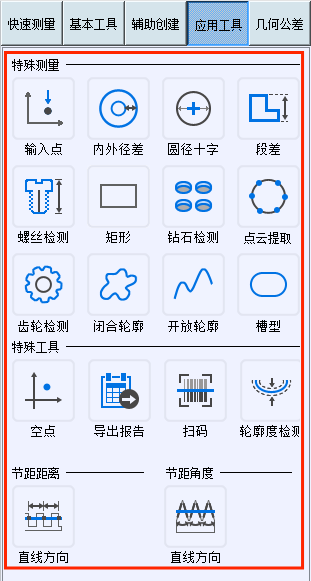
Traditional measurement software may require operators to memorize complex commands or code. Today, leading measurement software utilizes intuitive graphical user interfaces (GUIs). All functions—such as lens control, lighting adjustment, motion control, and measurement tools—are clearly presented in the form of icons, buttons, and sliders. Even more important is the “teach-in programming” mode: Users do not need to write any code. Instead, they simply click, drag, and select the points, lines, circles, and other features they wish to measure on the live image. The software automatically records these actions and parameters, generating a repeatable measurement program. This makes programming as simple as “recording a macro.”
Extensive Measurement Tools and Automatic Matching: Enhancing Programming Efficiency
The software features a comprehensive library of measurement tools, including not only basic points, lines, circles, and arcs, but also various construction and evaluation tools such as distance, angle, intersection, and symmetry. For features with regular patterns (such as array holes or grids), the software typically offers **array copying, pattern recognition (Pattern Match), or contour matching (CAD alignment)** functions. Users need only create a measurement program for a single feature; the software can then automatically identify and generate measurement programs for all other identical features, significantly reducing programming time.
One-Click Automation and Batch Processing: Enabling Unattended Operation
Once the program is written, its true value lies in automated execution. High-quality software supports one-click initiation of fully automated measurement: the equipment automatically moves to the starting position and sequentially completes the entire process—focusing, capturing images, measuring, evaluating, and generating reports. For multiple identical workpieces, batch measurement can be configured; after the operator loads the parts once, the equipment automatically completes inspection for all workpieces. Some high-end software can also integrate with robotic arms or automated loading/unloading systems to achieve true unmanned online inspection.
Smart Focusing and Edge Detection: Ensuring Measurement Stability
The software integrates multiple auto-focusing algorithms (such as sharpness evaluation functions and laser focusing) to quickly locate the optimal focal plane, ensuring image clarity. The automatic edge extraction feature intelligently identifies areas with the most dramatic changes in contrast within the image as edges, reducing the subjective impact of manually defined thresholds and improving measurement repeatability.
Robust Data Management and SPC Analysis: From Measurement to Management
The completion of a measurement is not the end of the process. Modern software can automatically store data from each measurement in a database and instantly generate formatted inspection reports (supporting multiple formats such as PDF and Excel). More importantly, these systems integrate powerful SPC (Statistical Process Control) analysis modules that automatically calculate CPK and PPK, and generate X-R control charts, trend charts, histograms, and more. This enables quality engineers to monitor the capability and stability of production processes in real time, thereby achieving preventive quality control.

It can be said that well-designed software encapsulates complex metrological knowledge behind simple operations. It frees operators from tedious, repetitive tasks and complex calculations, allowing them to focus on designing measurement plans and analyzing results. This is precisely the goal pursued by measurement software like Promis: through unparalleled ease of use and powerful automation features, it enables a broader range of frontline personnel to master high-precision measurement technology, thereby truly transforming it into corporate productivity.
Product recommendation
TECHNICAL SOLUTION
MORE+You may also be interested in the following information
FREE CONSULTING SERVICE
Let’s help you to find the right solution for your project!
 ASK POMEAS
  PRICE INQUIRY
  REQUEST DEMO/TEST
  FREE TRIAL UNIT
  ACCURATE SELECTION
- APPICATION CASE
- RESOURCE CENTER
- DOWNLOAD CENTER
SOLUTIONS SUPPORT
- ZOOM LENS SELECTION TOOL
- TELECENTRIC LENS SELECTION TOOL
- FA LENS SELECTION TOOL
- ZOOM RATIO TABLE
- CERTIFIED MODEL
SELECTION TOOL
- WHY POMEAS
- FAQ
- PRIVACY POLICY
- TERMS OF USE
- DELIVERY & RETURN POLICY
CUSTOMER CARE
 ADDRESS
Add.:No.68, Chongwei Road, Baizhoubian, East district, Dongguan, China, 523000
CONTACT
 Tel:+ 86-0769-2266 0867
 Fax:+ 86-0769-2266 0867
 E-mail:marketing@pomeas.com

Wechat QR code

Software Copyright :2021SR0176001 抄袭必究, 技术支持:誉新源科技