


Analysis of the Key Features of High-Precision Telecentric Lenses
In the fields of precision manufacturing and machine vision inspection, high-precision telecentric lenses have become critical components for enhancing measurement stability. Unlike standard industrial lenses, telecentric lenses utilize a parallel optical path design to eliminate perspective distortion and parallax error at the source, ensuring that the imaged dimensions remain unaffected by slight changes in object distance.

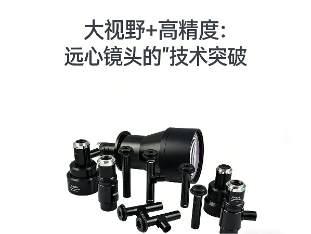
In the fields of precision manufacturing and machine vision inspection, high-precision telecentric lenses have long transcended their role as mere “auxiliary components” to become core equipment that ensures measurement accuracy and enhances production efficiency. Compared to standard industrial lenses, telecentric lenses, with their unique parallel optical path design, fundamentally resolve the common issues of perspective distortion and parallax error found in traditional lenses. This ensures that the imaged dimensions remain consistently stable, unaffected by slight changes in object distance—a key factor in their ability to perform reliably in micrometer-level inspection scenarios.
The core characteristics of high-precision telecentric lenses are distinct, with four key advantages standing out: low distortion, high depth of field, constant magnification, and sharp edge definition. Typically, the distortion rate of high-quality telecentric lenses can be strictly controlled within 0.1%, with some high-end products achieving as low as 0.05%. This means that when inspecting minute components, the image will not exhibit “near-large, far-small” distortion, ensuring that measurement data closely matches the actual dimensions of the workpiece. The deep depth of field allows parts with significant height differences to be imaged clearly in a single shot, eliminating the need for repeated refocusing and significantly improving inspection efficiency. This makes them particularly suitable for batch inspection of complex structural components.
Constant magnification is another key feature that distinguishes telecentric lenses from standard lenses. Even if the workpiece moves slightly within the inspection range, the magnification remains constant, effectively preventing measurement errors caused by workpiece displacement. Additionally, telecentric lenses provide uniform imaging across the entire field of view, with consistent sharpness from the edges to the center. This eliminates the “sharp center, blurry edges” issue common in standard lenses, providing a reliable foundation for subsequent image analysis and data calculation.


In real-world industrial applications, the value of these features is fully realized. Whether it’s measuring connector pins or inspecting PCB pads in the 3C electronics sector, inspecting gear tooth profiles or piston bore diameters in the automotive parts industry, or verifying the dimensions of needles and catheters in the medical device field, all of these applications require this “what you see is what you get” imaging capability to prevent misjudgments and rework caused by image distortion. Currently, mature telecentric lens solutions in the industry predominantly employ a double-sided telecentric structure to ensure precision on both the object and image sides. As a company specializing in precision optical components, POMEAS’s high-precision telecentric lenses have become the top choice for numerous automated production lines due to their stable performance. Long-term use not only reduces the frequency of calibration but also lowers the costs associated with false positives, thereby supporting enterprises in enhancing their quality control standards.
Product recommendation
TECHNICAL SOLUTION
MORE+You may also be interested in the following information
FREE CONSULTING SERVICE
Let’s help you to find the right solution for your project!
 ASK POMEAS
  PRICE INQUIRY
  REQUEST DEMO/TEST
  FREE TRIAL UNIT
  ACCURATE SELECTION
- APPICATION CASE
- RESOURCE CENTER
- DOWNLOAD CENTER
SOLUTIONS SUPPORT
- ZOOM LENS SELECTION TOOL
- TELECENTRIC LENS SELECTION TOOL
- FA LENS SELECTION TOOL
- ZOOM RATIO TABLE
- CERTIFIED MODEL
SELECTION TOOL
- WHY POMEAS
- FAQ
- PRIVACY POLICY
- TERMS OF USE
- DELIVERY & RETURN POLICY
CUSTOMER CARE
 ADDRESS
Add.:No.68, Chongwei Road, Baizhoubian, East district, Dongguan, China, 523000
CONTACT
 Tel:+ 86-0769-2266 0867
 Fax:+ 86-0769-2266 0867
 E-mail:marketing@pomeas.com

Wechat QR code

Software Copyright :2021SR0176001 抄袭必究, 技术支持:誉新源科技