


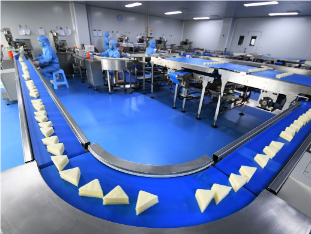
In modern industrial production and scientific research, high-precision dimensional measurement is a critical factor in ensuring product quality, improving production efficiency, and driving technological innovation. Conventional high-precision measuring equipment plays a vital role in many static measurement scenarios due to the convenience of one-click rapid measurement. However, when dealing with moving objects, achieving high-precision dimensional measurement becomes a significant challenge.

Limitations of Conventional High-Precision Measuring Equipment

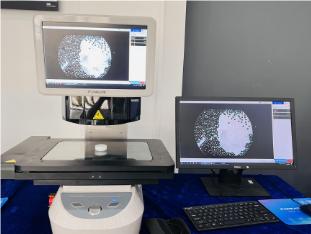
Conventional high-precision measurement equipment typically operates by placing the product securely on a measurement platform, using a lens to project a clear image of the product onto a screen, and then employing advanced AI-powered measurement software to quickly and accurately determine the product’s contour dimensions. This measurement method performs exceptionally well in static environments and meets the dimensional accuracy requirements of most standard products.
Take the electronic component manufacturing industry as an example. During production, various tiny electronic components must be measured to ensure they meet design specifications. Conventional measurement equipment can easily handle such static measurement tasks; through precise projection and intelligent algorithm analysis, it quickly derives component dimensional data, providing a reliable basis for production quality control. However, when the object being measured is in motion, the situation becomes more complex. Moving objects are subject to factors such as velocity, acceleration, and vibration, which can cause blurring and distortion in the projected image. This makes it difficult for AI-powered measurement software to accurately identify and measure the product’s contour dimensions, thereby compromising measurement accuracy.
Challenges in Measuring Moving Objects

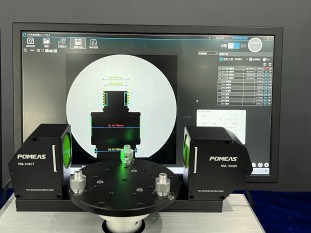
Measuring moving objects is fraught with difficulties, primarily due to several factors.
1. The object’s speed is a key factor. When an object is moving at high speed, it has already shifted position by the time the camera captures the image, resulting in motion blur in the projected image. This causes the edges of the outline to become blurred, making it impossible to accurately define the boundaries of the object’s dimensions.
2. The object’s motion trajectory can also affect measurement results. If the object exhibits irregular oscillations or rotations during movement, the shape and position of the projected image will constantly change, further complicating the measurement process.
3. Environmental factors such as changes in lighting and vibration interference can also negatively impact measurement accuracy.
Telecentric Measurement System: A Breakthrough in Motion Measurement

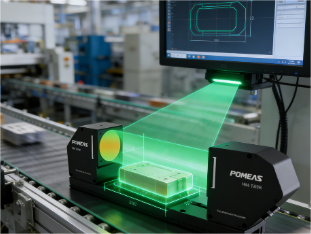
To overcome the limitations of conventional measuring equipment in measuring moving objects, Telecentric Measurement Systems have emerged. A Telecentric Measurement System is an advanced device that supports real-time product dimension measurement. It offers unique advantages, enabling it to quickly and accurately project product contours and measure product dimensions even when the object being measured is in motion.
Telecentric Measurement Systems utilize high-speed, high-precision image capture technology to capture clear images of moving objects in a very short time. Equipped with high-performance lenses and advanced image processing algorithms, they effectively minimize the effects of motion blur and image distortion, ensuring the quality of the projected image. Additionally, these systems feature real-time tracking and dynamic compensation capabilities, automatically adjusting measurement parameters based on the object’s motion to achieve continuous, stable measurement of moving objects.
Take semiconductor chip manufacturing as an example. During the chip production process, real-time dimensional monitoring of the microscopic structures on the chip is required. Since chips move at high speeds on the production line, traditional measurement equipment cannot meet these measurement requirements. In contrast, the Telecentric Measurement System can track the movement of the chip in real time, quickly and accurately measure the dimensions of various structures on the chip, and promptly detect dimensional deviations during production. This provides timely feedback for production process adjustments and optimization, effectively improving chip production quality and efficiency.
With continuous technological advancements, the performance of Telecentric Measurement Systems will continue to improve, and their application areas will expand further. In high-end manufacturing and research fields such as aerospace, precision machinery, and biomedicine, the demand for high-precision dimensional measurement of moving objects is growing, and Telecentric Measurement Systems will play an increasingly vital role. At the same time, the integration of emerging technologies such as artificial intelligence and big data will endow Telecentric Measurement Systems with more powerful intelligent analysis and decision-making capabilities, enabling them to better adapt to complex and dynamic measurement scenarios and provide robust support for the advancement of various industries.
Product recommendation
TECHNICAL SOLUTION
MORE+You may also be interested in the following information
FREE CONSULTING SERVICE
Let’s help you to find the right solution for your project!
 ASK POMEAS
  PRICE INQUIRY
  REQUEST DEMO/TEST
  FREE TRIAL UNIT
  ACCURATE SELECTION
- APPICATION CASE
- RESOURCE CENTER
- DOWNLOAD CENTER
SOLUTIONS SUPPORT
- ZOOM LENS SELECTION TOOL
- TELECENTRIC LENS SELECTION TOOL
- FA LENS SELECTION TOOL
- ZOOM RATIO TABLE
- CERTIFIED MODEL
SELECTION TOOL
- WHY POMEAS
- FAQ
- PRIVACY POLICY
- TERMS OF USE
- DELIVERY & RETURN POLICY
CUSTOMER CARE
 ADDRESS
Add.:No.68, Chongwei Road, Baizhoubian, East district, Dongguan, China, 523000
CONTACT
 Tel:+ 86-0769-2266 0867
 Fax:+ 86-0769-2266 0867
 E-mail:marketing@pomeas.com

Wechat QR code

Software Copyright :2021SR0176001 抄袭必究, 技术支持:誉新源科技