


Differences Between 3D Line Laser Profile Sensors and Standard Laser Sensors
I. Differences in the Dimensions of Operating Principles

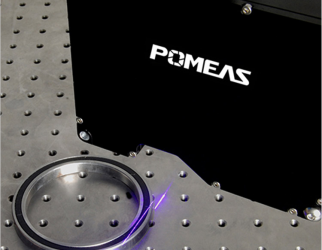
1. How Standard Laser Sensors (Point Lasers) Work
Conventional laser sensors (typically referring to laser displacement sensors or laser rangefinders) emit a single-point laser beam. When this light spot strikes the surface of an object, the sensor receives the reflected light and calculates the distance to that point using triangulation or time-of-flight methods. The output is a single numerical value—namely, the distance from the measured point to the sensor.
In practical applications, if one wishes to measure the height of all solder joints on an FPGA chip, a standard laser sensor must rely on a robotic arm or a precision motion platform to scan each solder joint individually. This process is not only time-consuming but also places extremely high demands on the precision and stability of the motion system.
2. How 3D Line Laser Profile Sensors Work
The 3D line laser profile sensor works entirely differently. It uses a specialized optical system to expand the laser beam into a static laser line that illuminates a single line on the object. This laser line covers dozens or even hundreds of solder joints, with each pixel along the line serving as an independent measurement unit.
The sensor’s built-in high-sensitivity CMOS camera captures the reflected light from the entire laser line. Based on the principle of triangulation, it calculates the 3D coordinates (including height Z and lateral position X) of all points along this line in a single pass. As the conveyor belt moves the PCB, the sensor continuously captures multiple profile lines, which are ultimately stitched together to form a 3D point cloud of the entire FPGA chip and all solder joints.
II. The Fundamental Difference Between Data Dimensions and Information Volume

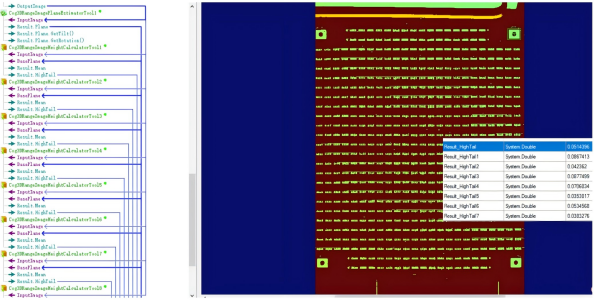
1. Limitations of Conventional Laser Sensors
Standard laser sensors provide planar distance information. In the context of FPGA solder joint inspection, this means:
-
Can only obtain the absolute height value of a single point
-
Cannot distinguish whether the point corresponds to the top of a solder joint, the chip itself, or the PCB substrate
-
Cannot obtain key quality parameters such as the shape, volume, and coplanarity of the solder joint
-
Requires a complex mechanical scanning mechanism and post-processing data alignment to barely reconstruct the contour
2. 3D Line Laser Profile Sensor
3D line laser profilometers provide complete 3D profile data. In FPGA solder joint inspection, this means:
-
Simultaneously capture X-axis position, Y-axis position, and Z-axis height
-
Generate the true 3D geometry of each weld, including top curvature and edge steepness
-
Calculate weld volume, projected area, and coplanarity error
-
Identify complex defects such as pillow effects, bridging, and tombstones
-
Implement fully automated pass/fail determination based on point cloud data
III. Comparison of Detection Efficiency

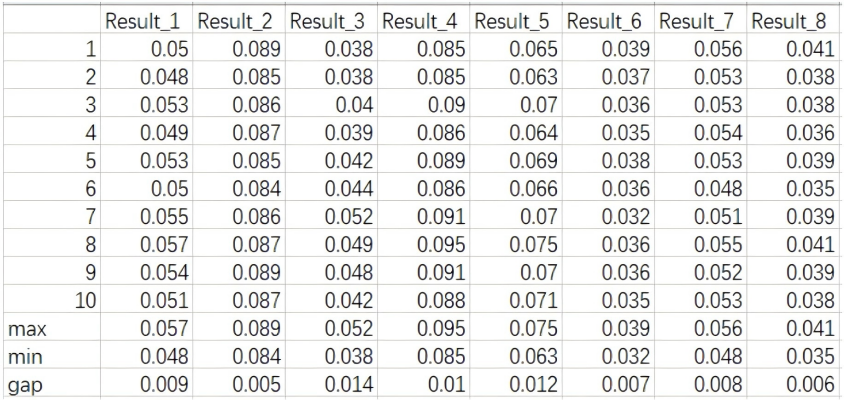
In a typical FPGA solder joint inspection application, suppose we need to inspect a chip containing 400 BGA solder joints:
-
Conventional laser sensor solution: If three points (center and edge points) need to be sampled for each solder joint, a total of 1,200 points must be captured. Assuming a sampling frequency of 10 kHz and a positioning time of 0.1 seconds per point for the motion mechanism, the total processing time exceeds 120 seconds. Additionally, motion control is complex, and there is a high risk of cumulative error.
-
3D Line Laser Profile Sensor Solution: A single laser line covers an entire row of 20 solder joints. Scanning at a profile frequency of 5 kHz, scanning the entire chip takes only 0.5–2 seconds (depending on the scan width), resulting in an efficiency improvement of tens to hundreds of times.
Product recommendation
TECHNICAL SOLUTION
MORE+You may also be interested in the following information
FREE CONSULTING SERVICE
Let’s help you to find the right solution for your project!
 ASK POMEAS
  PRICE INQUIRY
  REQUEST DEMO/TEST
  FREE TRIAL UNIT
  ACCURATE SELECTION
- APPICATION CASE
- RESOURCE CENTER
- DOWNLOAD CENTER
SOLUTIONS SUPPORT
- ZOOM LENS SELECTION TOOL
- TELECENTRIC LENS SELECTION TOOL
- FA LENS SELECTION TOOL
- ZOOM RATIO TABLE
- CERTIFIED MODEL
SELECTION TOOL
- WHY POMEAS
- FAQ
- PRIVACY POLICY
- TERMS OF USE
- DELIVERY & RETURN POLICY
CUSTOMER CARE
 ADDRESS
Add.:No.68, Chongwei Road, Baizhoubian, East district, Dongguan, China, 523000
CONTACT
 Tel:+ 86-0769-2266 0867
 Fax:+ 86-0769-2266 0867
 E-mail:marketing@pomeas.com

Wechat QR code

Software Copyright :2021SR0176001 抄袭必究, 技术支持:誉新源科技