


3D Line Laser Profile Sensor | Gear Inspection for Injection-Molded Parts
In the field of precision manufacturing, the dimensional accuracy and surface quality of injection-molded gears directly impact the transmission efficiency and service life of mechanical systems. Traditional contact-based measurement methods are prone to scratching gear surfaces and struggle to capture details on complex curved surfaces; meanwhile, 2D vision inspection is limited to planar data and cannot identify three-dimensional defects. Leveraging its non-contact, high-precision, and all-scenario adaptability, the 3D line laser profilometer, combined with the intelligent algorithms of the METX multi-sensor system, provides a breakthrough solution for the inspection of injection-molded gears, enabling comprehensive quality control ranging from geometric dimensions to microscopic defects.

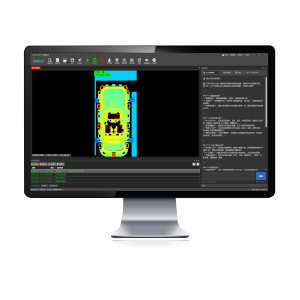
Principles of the Solution

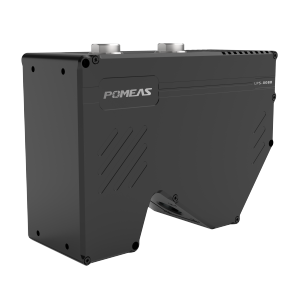
The core of the 3D line laser profilometer is based on the principle of laser triangulation: the sensor emits a blue laser line (wavelength 405 nm), which is projected onto the gear surface to form a speckle of diffuse reflection; a high-resolution CMOS camera captures changes in the path of the reflected light and calculates the three-dimensional coordinates of the surface using trigonometric relationships. Compared to traditional point laser scanning, line lasers can acquire tens of thousands of profile points in a single scan, with a sampling frequency of up to 49 kHz, achieving micron-level repeatability (±0.2 μm). This makes them particularly suitable for rapid scanning of fine structures such as gear tooth faces and roots.
The METX multi-sensor system further integrates multi-modal sensors such as spectral confocal and white-light interferometry, intelligently switching measurement modes to address challenges posed by different materials. For example, when scanning highly reflective metal gears, the system automatically activates a narrow-band filter to suppress ambient light interference; for transparent plastic gears, it switches to white-light interferometry mode to achieve sub-nanometer-level surface roughness detection. This multi-sensor collaboration mechanism ensures comprehensive data coverage ranging from macroscopic dimensions to microscopic defects.
Application Scenarios

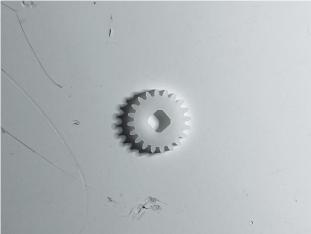
1. Rapid 3D Modeling: Reconstructing Gear Geometry with Millimeter-Level Accuracy
Taking an injection-molded gear for an automotive transmission as an example, a traditional coordinate measuring machine (CMM) requires point-by-point probing, taking 15 minutes to inspect a single gear; in contrast, a 3D line laser sensor equipped with the METX system rapidly generates a complete point cloud model through 3-axis synchronized scanning and adaptive stitching algorithms. The model contains X/Y/Z coordinate data, providing a visual representation of key parameters such as the pitch circle diameter and cumulative pitch error.
2. Intelligent Defect Recognition: From Micron-Level Scratches to Macro-Level Deformations
During the injection molding process, gears may develop defects such as flash, sink marks, and warping due to mold wear or process fluctuations. The METX system features a built-in library of deep learning algorithms that can automatically classify defect types:
- Surface Defect Detection: Identifies micron-level scratches on gear surfaces (such as machining marks 0.01 mm deep) using a height difference algorithm, and detects localized indentations on the root circle using a plane fitting algorithm;
- Geometric Tolerance Analysis: Utilizes CAD model comparison functions to quantify flatness errors on gear mating surfaces (such as warping within ±0.05 mm), ensuring precise mating with the drive shaft;
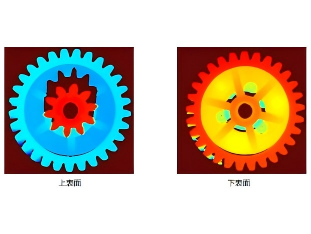
- Microstructural Verification: For involute tooth profiles, the system generates a deviation histogram comparing the actual tooth profile curve with the theoretical model, visually displaying the distribution of tooth profile errors to guide mold repair and adjustment.
Display of Test Results

Technical Advantages of Laser 3D Profile Sensors

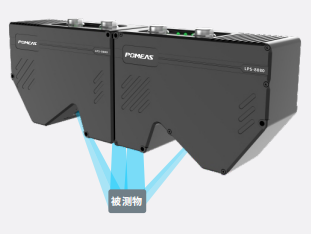
1. Ultra-high-speed scanning: With a 49 kHz sampling rate and 4K ultra-high-resolution imaging, each frame captures 1,280 contour points, easily handling dynamic inspection of high-speed rotating gears;
2. Anti-interference design: The combination of a 405 nm blue laser wavelength and a narrow-band filter effectively suppresses metal reflections and ambient light interference, ensuring data stability;
3. Intelligent Algorithm Library: Features over 30 built-in algorithms, including plane fitting, height matching, and defect detection, and supports rapid configuration of inspection workflows via SGVision vision software, reducing development costs;
Product recommendation
TECHNICAL SOLUTION
MORE+You may also be interested in the following information
FREE CONSULTING SERVICE
Let’s help you to find the right solution for your project!
 ASK POMEAS
  PRICE INQUIRY
  REQUEST DEMO/TEST
  FREE TRIAL UNIT
  ACCURATE SELECTION
- APPICATION CASE
- RESOURCE CENTER
- DOWNLOAD CENTER
SOLUTIONS SUPPORT
- ZOOM LENS SELECTION TOOL
- TELECENTRIC LENS SELECTION TOOL
- FA LENS SELECTION TOOL
- ZOOM RATIO TABLE
- CERTIFIED MODEL
SELECTION TOOL
- WHY POMEAS
- FAQ
- PRIVACY POLICY
- TERMS OF USE
- DELIVERY & RETURN POLICY
CUSTOMER CARE
 ADDRESS
Add.:No.68, Yongwei Road, Baizhoubian, Dongcheng District, Dongguan, China,523000
CONTACT
 Tel:+ 86-0769-2266 0867
 Fax:+ 86-0769-2266 0867
 E-mail:marketing@pomeas.com

Wechat QR code

Software Copyright :2021SR0176001 抄袭必究, 技术支持:誉新源科技