


What is a 3D line laser profile scanning sensor?

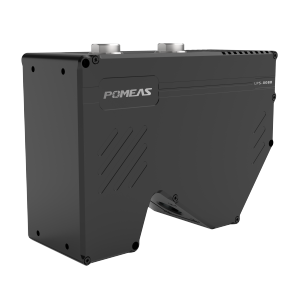
If a 2D laser sees “a line,” then a 3D line laser profilometer sees “a surface” or even “a solid.”
The working principle of a 3D line laser essentially adds a dimension of motion to the 2D approach. As the sensor moves relative to the object (for example, via a conveyor belt or robotic arm), it continuously captures hundreds or thousands of 2D profile lines. By stacking these “lines” on top of one another, it reconstructs a three-dimensional point cloud model of the object.
Key Features: 3D Reconstruction and Full-Dimensional Inspection

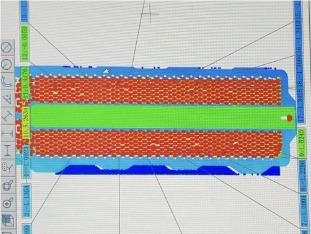
With complete 3D point cloud data, inspection is no longer limited to a single cross-section but encompasses the entire object:
1. Complex Surface Measurement: In the 3C electronics industry, this involves inspecting the surface flatness of laptop C-panels and the curvature of smartwatch cases. While 2D inspection struggles to locate the highest points on a surface, 3D models allow for direct global analysis.
2. Volume and Step Height Analysis: In lithium-ion battery manufacturing, inspecting the boundaries of electrode sheet coating, the protrusion height of fishscale patterns on weld seams, and their volume; in adhesive path inspection, not only can width be measured, but the actual volume of the adhesive can also be calculated.
3. Reverse Engineering: For legacy parts without CAD drawings, 3D line lasers can quickly scan to generate point clouds, which can then be imported into software to directly create editable 3D models.
Technical Advantages: Multi-dimensional Information Density

-
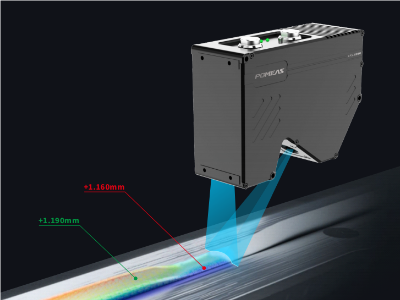
Comprehensive Data: Outputs X, Y, and Z-axis data, enabling the generation of grayscale images, height maps, and point clouds.
-
Eliminates blind spots: Combined with multi-sensor stitching technology, it enables 360-degree, blind-spot-free detection of objects (such as rail tracks and pipelines).
-
High material adaptability: Modern 3D profilometers utilize blue light technology to effectively suppress interference from highly reflective surfaces (such as mirror-polished metal parts) or black, light-absorbing objects, ensuring cleaner data acquisition.
Product recommendation
TECHNICAL SOLUTION
MORE+You may also be interested in the following information
FREE CONSULTING SERVICE
Let’s help you to find the right solution for your project!
 ASK POMEAS
  PRICE INQUIRY
  REQUEST DEMO/TEST
  FREE TRIAL UNIT
  ACCURATE SELECTION
- APPICATION CASE
- RESOURCE CENTER
- DOWNLOAD CENTER
SOLUTIONS SUPPORT
- ZOOM LENS SELECTION TOOL
- TELECENTRIC LENS SELECTION TOOL
- FA LENS SELECTION TOOL
- ZOOM RATIO TABLE
- CERTIFIED MODEL
SELECTION TOOL
- WHY POMEAS
- FAQ
- PRIVACY POLICY
- TERMS OF USE
- DELIVERY & RETURN POLICY
CUSTOMER CARE
 ADDRESS
Add.:No.68, Yongwei Road, Baizhoubian, Dongcheng District, Dongguan, China,523000
CONTACT
 Tel:+ 86-0769-2266 0867
 Fax:+ 86-0769-2266 0867
 E-mail:marketing@pomeas.com

Wechat QR code

Software Copyright :2021SR0176001 抄袭必究, 技术支持:誉新源科技