


The Top Choice for High-Precision Measurement—Twin Telecentric Lenses
In the world of industrial automation and precision measurement, data reliability is the cornerstone of decision-making. However, there is one source of error that is often overlooked, yet may be quietly undermining the validity of your measurement results—optical distortion in the lens.
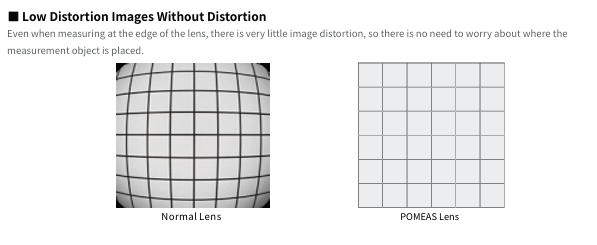
Challenges in Lens Design: Image Distortion
Imagine using a ruler with uneven markings to measure a product. No matter how carefully you do it, the results will be inaccurate from the very start. In machine vision, the distortion caused by traditional lenses acts just like this “inaccurate ruler.”
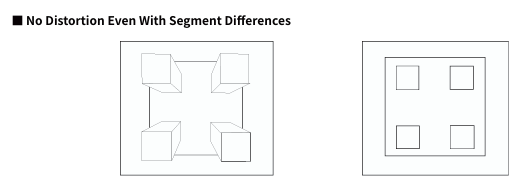
Optical distortion, simply put, is the phenomenon where a lens fails to reproduce the true, straight lines of an object as straight lines in the image. It primarily manifests as “barrel distortion” (where the edges of the image curve inward) and “pincushion distortion” (where the edges of the image bulge outward). In precision dimensional measurement, particularly when measuring features located at the edges of the field of view, this distortion introduces systematic errors that are difficult to correct simply through software. For example, when measuring the center-to-center distance between two holes on a precision part, if these holes are located near the edges of the image, lens distortion can cause the measured value to deviate from the true value by several micrometers or more. This is unacceptable for high-end manufacturing, where tolerances are in the micrometer range. Such errors are inherent and non-linear, directly reducing measurement accuracy and consistency across the field of view.
Solution: How Do Double-Telecentric Lenses Achieve the Imaging Miracle of “Near-Zero Distortion”?

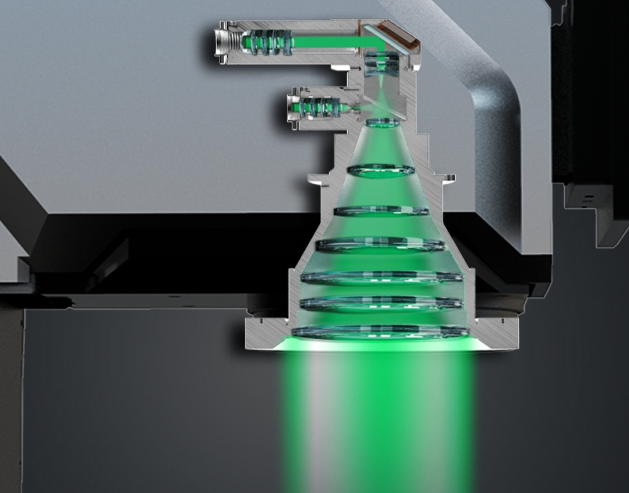
The reason double-telecentric lenses are hailed as the “gold standard” of precision measurement lies in their “near-zero distortion” characteristic. Here, “zero distortion” does not refer to zero in the strict mathematical sense, but rather to distortion that is controlled to an extremely low level (typically 0.1% or even lower) through highly precise optical design. As a result, its impact on measurement results is far smaller than other system errors, making it practically negligible in engineering applications.
This achievement stems from the synergy between its dual-telecentric design and high-quality optical elements:
- Symmetry and Correction Design: Dual telecentric lenses employ a highly symmetrical lens group structure and specialized optical correction techniques to precisely control the entire path of light from entry to imaging, thereby maximizing the elimination of aberrations that cause distortion.
- Advantages of Parallel Light Paths: Their object-side telecentric characteristics (where light enters the lens in parallel) inherently reduce perspective errors caused by changes in viewing angle, which also helps maintain geometric consistency across the entire image plane.
- Full-Field Uniformity: The result is that the change in magnification from the center of the image to the four corners at the very edges is negligible. This means that regardless of where a feature is located within the field of view, the actual physical size represented by a single pixel in the image remains nearly constant. This provides the physical foundation for true “what you see is what you measure,” ensuring that measurements across the entire field of view have a consistent and reliable scale standard.
Application Scenarios: Cutting-edge fields with “zero tolerance” for distortion

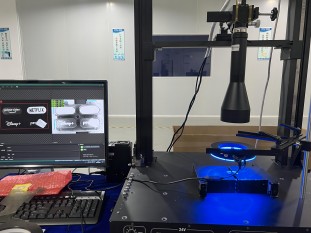
- 2D Precision Measurement and Calibration: Used for calibrating standard blocks, optical encoders, high-precision molds, and fixtures. The measurement data itself can serve as a secondary standard to calibrate the entire quality control system.
- Semiconductors and Microelectronic Components: Measures the diameter and spacing of chip solder balls, as well as the width and coplanarity of connector pins. Even the slightest distortion can lead to misjudgments regarding connection reliability, posing potential quality risks.
- Scientific Image Analysis and High-Definition Digital Mapping: When performing high-precision feature extraction, morphological analysis, or creating digital templates from acquired images, it is essential to ensure the geometric accuracy of the images; dual-telecentric lenses provide this geometric fidelity.
How can you verify and choose a true low-distortion lens?
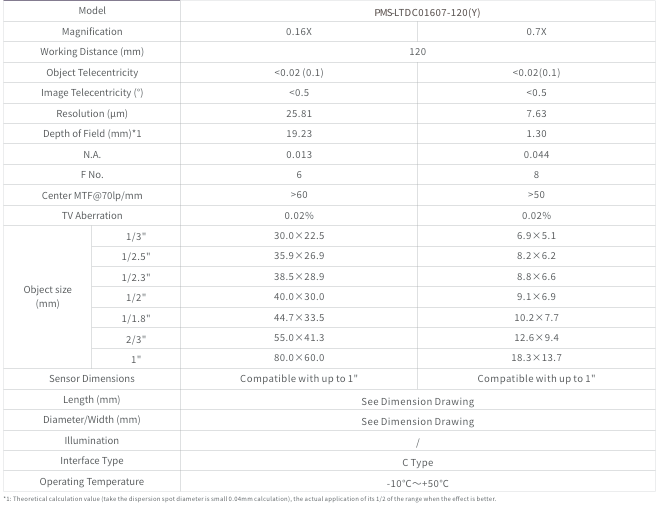
- Key Parameters: Carefully review the “absolute distortion” or “TV distortion” values in the technical specifications. This is a percentage value, and the lower the better. Typically, the distortion value for dual-telecentric lenses used for metrology must be better than 0.1%.
- Field Verification: The most reliable method is to photograph a certified high-precision standard grid plate (such as a Checkerboard or Dot Grid) with the lens under test, then analyze the image using professional calibration software to directly observe and quantify the degree of line curvature.
- System Balance: While striving for low distortion, it is also necessary to balance this with other key parameters such as resolution, working distance, and depth of field. Select the model that best suits your measurement accuracy requirements and on-site space constraints.
Product recommendation
TECHNICAL SOLUTION
MORE+You may also be interested in the following information
FREE CONSULTING SERVICE
Let’s help you to find the right solution for your project!
 ASK POMEAS
  PRICE INQUIRY
  REQUEST DEMO/TEST
  FREE TRIAL UNIT
  ACCURATE SELECTION
- APPICATION CASE
- RESOURCE CENTER
- DOWNLOAD CENTER
SOLUTIONS SUPPORT
- ZOOM LENS SELECTION TOOL
- TELECENTRIC LENS SELECTION TOOL
- FA LENS SELECTION TOOL
- ZOOM RATIO TABLE
- CERTIFIED MODEL
SELECTION TOOL
- WHY POMEAS
- FAQ
- PRIVACY POLICY
- TERMS OF USE
- DELIVERY & RETURN POLICY
CUSTOMER CARE
 ADDRESS
Add.:No.68, Yongwei Road, Baizhoubian, Dongcheng District, Dongguan, China,523000
CONTACT
 Tel:+ 86-0769-2266 0867
 Fax:+ 86-0769-2266 0867
 E-mail:marketing@pomeas.com

Wechat QR code

Software Copyright :2021SR0176001 抄袭必究, 技术支持:誉新源科技