


Spectral Confocal Displacement Sensor: Transparent Materials/Highly Reflective
Background

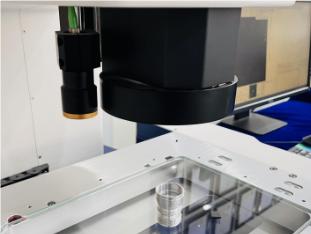
In the fields of precision manufacturing and high-end inspection, measurement accuracy at the micro-scale often determines the quality of a product. However, traditional laser displacement sensors often fall short when dealing with highly reflective metals, transparent glass, black rubber, or inclined curved surfaces—reflection causes signal saturation, transparency in materials leads to measurement failure, and inclined surfaces result in data fluctuations due to insufficient backlight. The industry urgently needs a non-contact measurement solution that offers micro- and nano-level accuracy while accommodating complex materials and surface conditions.
I. Principles
The spectral confocal displacement sensor consists of a white light source and a dispersive lens assembly. When broad-spectrum white light passes through the dispersive lens, light of different wavelengths is focused at different heights, resulting in axial dispersion.
II. Nanometer-Level Resolution and Ultra-Wide-Angle Adaptability
In high-end applications such as wafer thickness measurement and sapphire glass flatness inspection, resolution requirements often reach the submicron or even nanometer level. Spectral confocal displacement sensors can achieve nanometer (nm) resolution and submicron linear accuracy, enabling clear detection of minute changes in coating thickness or subtle topographical variations on bearing surfaces.
More importantly, they are insensitive to the tilt angle of the measured surface. Thanks to the confocal optical design, the sensor can still reliably capture reflected light signals even when the angle between the sensor and the measured surface reaches ±30° or greater (depending on the lens model). This makes it an ideal tool for measuring the curvature of spherical lenses, the profile of gear tooth surfaces, and the curved surfaces of rivet heads—overcoming the shortcoming of triangulation-based laser sensors, which are prone to failure at large angles of incidence.
III. Measurement of Transparent Materials and Multilayer Structures: One Machine, Multiple Uses
Traditional sensors often fail to detect surface positions when dealing with glass, thin films, or transparent adhesive layers. Spectral confocal displacement sensors focus light of different wavelengths onto the upper and lower surfaces of a transparent object, respectively, and extract two or more peaks from the reflected spectrum to determine the thickness of each layer in a multi-layer transparent material in a single measurement. For example, in the lamination process for smartphone cover glass, the sensor can simultaneously measure the positions of the glass’s top surface, the OCA adhesive layer, and the bottom surface, calculating the adhesive layer thickness and lamination flatness in real time. In applications such as camera module assembly and lens centering, it can also accurately measure air gap thickness or the spacing between lenses.
IV. Non-contact and Wear-Free, Suitable for Soft/Fragile Workpieces
For fragile or soft surfaces such as silicon wafers, sapphire, optical films, and coatings, contact-based measurement may cause scratches or deformation. Spectral confocal measurement uses a non-contact method that applies no force, so it does not damage the workpiece surface. Furthermore, since the sensor itself is not subject to mechanical wear, there is no need to replace the probe over the long term, resulting in significantly reduced maintenance costs.
Key Insights on Application Scenarios:

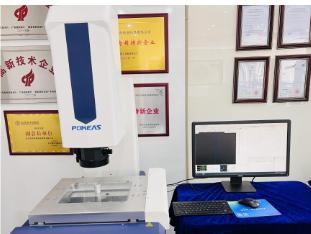
From measuring the thickness of semiconductor wafers, active alignment of camera modules, and scanning the curvature of glass covers, to analyzing the profiles of precision bearing raceways and inspecting the inner and outer diameters of medical catheters, spectral confocal displacement sensors—with their nanometer-level precision, angle-insensitivity, and ability to measure transparent materials—have become key components in overcoming the limitations of traditional inspection methods.
Product recommendation
TECHNICAL SOLUTION
MORE+You may also be interested in the following information
FREE CONSULTING SERVICE
Let’s help you to find the right solution for your project!

 ASK POMEAS
  PRICE INQUIRY
  REQUEST DEMO/TEST
  FREE TRIAL UNIT
  ACCURATE SELECTION
- APPICATION CASE
- RESOURCE CENTER
- DOWNLOAD CENTER
SOLUTIONS SUPPORT
- ZOOM LENS SELECTION TOOL
- TELECENTRIC LENS SELECTION TOOL
- FA LENS SELECTION TOOL
- ZOOM RATIO TABLE
- CERTIFIED MODEL
SELECTION TOOL
- WHY POMEAS
- FAQ
- PRIVACY POLICY
- TERMS OF USE
- DELIVERY & RETURN POLICY
CUSTOMER CARE
 ADDRESS
Add.:No.68, Yongwei Road, Baizhoubian, Dongcheng District, Dongguan, China,523000
CONTACT
 Tel:+ 86-0769-2266 0867
 Fax:+ 86-0769-2266 0867
 E-mail:marketing@pomeas.com

Wechat QR code

Software Copyright :2021SR0176001 抄袭必究, 技术支持:誉新源科技