


The core imaging lenses used in die-attach machines are primarily divided into three categories: optical microscope lenses, CCD camera lenses and infrared lenses. Each type of lens serves a specific purpose, catering to different operating conditions and precision requirements within the precision die-attach process; they are the key components that ensure the accuracy of chip alignment, bonding and inspection during die-attach.

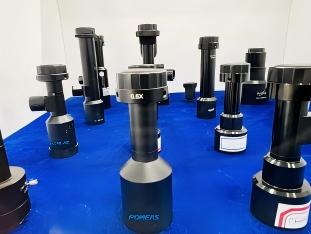
Optical microscope lenses are the fundamental core lenses for die-attach equipment, specialising in ultra-high-magnification imaging and detail magnification. These lenses feature adjustable magnification, low distortion and a large depth of field, enabling them to clearly capture microscopic details of tiny chips, pins and pads, and accurately assist both operators and equipment in achieving high-precision alignment and bonding operations. They are primarily used in standard precision die-attach applications and are suited to the die-attach processes of micro-components such as Mini LEDs and small semiconductor chips. They effectively mitigate issues such as bonding misalignment and positioning errors, thereby meeting the imaging requirements of basic precision manufacturing processes.

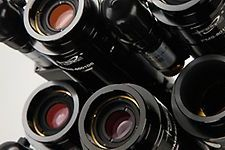
CCD cameras are the mainstream configuration for automated die-attach production. Thanks to their high light sensitivity, high frame rate and stable imaging, they are well-suited to automated assembly line operations. Compared to standard lenses, CCD cameras are more resistant to ambient light interference and deliver uniform, stable image quality. They can rapidly perform real-time image capture, transmission and feedback, meeting the dynamic recognition requirements of high-speed die-attach equipment. They are primarily used in high-volume, standardised chip die-bonding production and are suitable for applications such as automated alignment, preliminary defect inspection and trajectory tracking of standard-sized components; they are the standard lenses for mass-production die-bonding equipment.
Infrared lenses are specialised lenses designed for specific operating conditions, utilising the advantages of infrared spectral imaging to overcome the limitations of visible light imaging. In dimly lit, reflective or environments with unusual light transmission conditions, standard lenses are prone to issues such as blurred images, reflections, glare and loss of detail; infrared lenses, however, can accurately capture infrared light, filter out ambient light interference and clearly display component contours and bonding gaps. They are primarily used for die-attach inspection and alignment tasks involving chips made of special materials, light-transmissive packaged components, and in complex lighting conditions.
According to actual measurement data from optical imaging processes in the industry, the appropriate combination of three types of lenses can significantly improve the precision and yield of die-attach production:
1. Optical microscope lenses can achieve micrometre-level imaging resolution, with alignment accuracy of up to ±2 μm;
2. CCD camera lenses support high-speed imaging at over 20 frames per second, making them suitable for high-speed die-attach operations exceeding 80 cycles per minute;
3. Infrared lenses can reduce the defect rate in complex lighting conditions by over 90 per cent, comprehensively ensuring the stability and precision of the die-attach process.
Product recommendation
TECHNICAL SOLUTION
MORE+You may also be interested in the following information
FREE CONSULTING SERVICE
Let’s help you to find the right solution for your project!
 ASK POMEAS
  PRICE INQUIRY
  REQUEST DEMO/TEST
  FREE TRIAL UNIT
  ACCURATE SELECTION
- APPICATION CASE
- RESOURCE CENTER
- DOWNLOAD CENTER
SOLUTIONS SUPPORT
- ZOOM LENS SELECTION TOOL
- TELECENTRIC LENS SELECTION TOOL
- FA LENS SELECTION TOOL
- ZOOM RATIO TABLE
- CERTIFIED MODEL
SELECTION TOOL
- WHY POMEAS
- FAQ
- PRIVACY POLICY
- TERMS OF USE
- DELIVERY & RETURN POLICY
CUSTOMER CARE
 ADDRESS
Add.:No.68, Yongwei Road, Baizhoubian, Dongcheng District, Dongguan, China,523000
CONTACT
 Tel:+ 86-0769-2266 0867
 Fax:+ 86-0769-2266 0867
 E-mail:marketing@pomeas.com

Wechat QR code

Software Copyright :2021SR0176001 抄袭必究, 技术支持:誉新源科技