


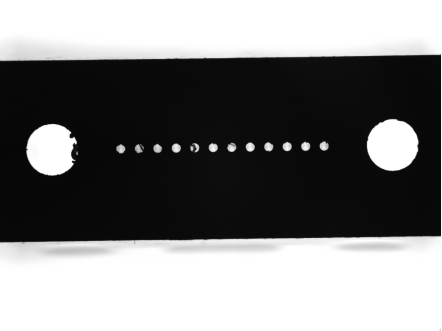
Thanks to a 65-megapixel global shutter camera, an infinity-focus optical lens and a parallel backlighting system, even micro-holes as small as 0.025 mm in diameter can be captured with sharp edges and extremely high contrast, thereby enabling sub-micron-level positioning accuracy.
I. Test Subject
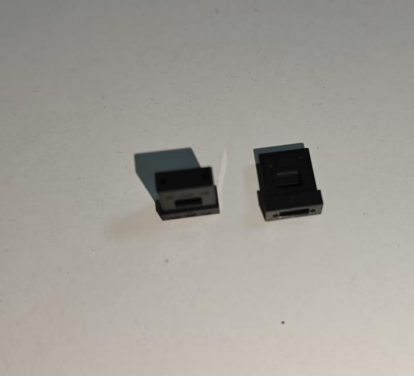
Plastic fibre-optic connector, with external dimensions of 7 mm × 3 mm. The connector is fitted with a precision socket, with an aperture of approximately 0.025 mm, designed for mating with a fibre-optic cable of 0.02 mm in diameter.
II. Background to the Requirement
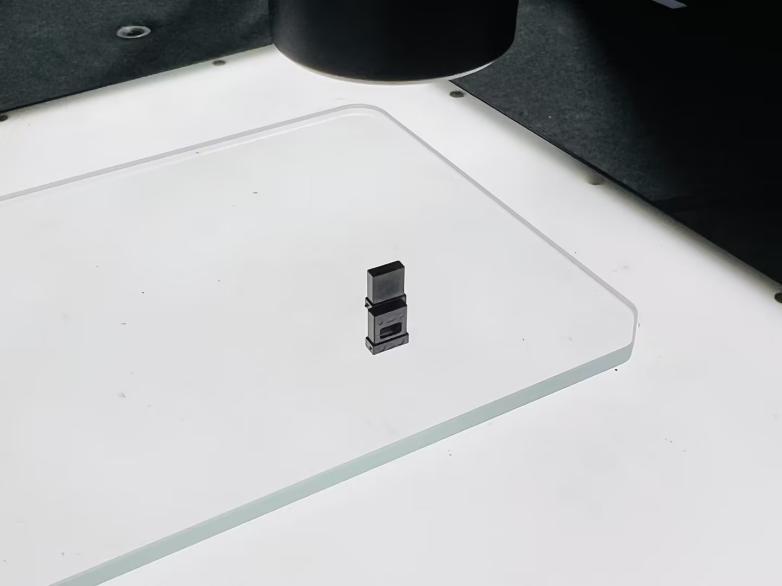
The end customer is a manufacturer of optical fibre products, whilst the inspection requirements were specified directly by a manufacturer of optical fibre production equipment. This equipment manufacturer is currently developing a new generation of automated optical fibre assembly equipment, which requires the precise insertion of optical fibre strands into the micro-holes of connectors. The vision system must be responsible for high-precision positioning, guiding the motion mechanism to complete alignment and insertion; the positioning accuracy for the entire process must be within 1 μm.
III. Challenges in Testing
The dimensions of the 0.025 mm diameter hole and the 0.02 mm diameter fibre are extremely small, leaving a very narrow gap between them. There are three significant challenges in obtaining sufficiently clear images of the hole position and the fibre end on an automated production line.
Firstly, standard industrial cameras have large pixels and low resolution, making them incapable of resolving such minute features; the edges of the holes often appear as a blurred mass, resulting in positioning repeatability that falls far short of 1 μm.
Secondly, conventional diffuse or annular lighting introduces diffuse reflection and edge effects, causing blurred edges and distortion in aperture measurements, making it difficult for machine vision algorithms to provide stable coordinates for the centre of the hole.
Thirdly, the compact space within the assembly equipment requires the optical system to maintain uniform illumination and high contrast even at short working distances, placing more stringent demands on the coordination between the lens and the light source.
After attempting several conventional solutions, equipment manufacturers have consistently been unable to reliably achieve sub-micrometre-level positioning, with both yield and cycle time being severely affected.
IV. Solutions
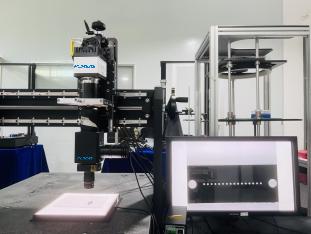
1.Industrial cameras:Equipped with a 65-megapixel camera and a GMAX3265 global shutter CMOS sensor, featuring a pixel size of 3.2 μm and a resolution of 9,344 × 7,000, it can clearly capture microscopic defects at the micrometre level. It supports high-speed 10-gigabit Ethernet transmission, ensuring both image quality and a stable frame rate.
2.Optical lenses:The M58-mount high-definition lens features an infinity optical design, is compatible with up to 2-inch objectives, and is compatible with flat-field, achromatic, long-working-distance objectives from all leading brands. Its professional coaxial optical path design ensures uniform illumination, a clear image and high contrast;
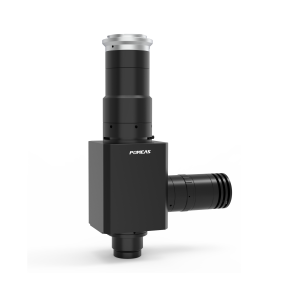
3.Visual light source:The flat, parallel light source is specifically designed for backlighting, with a parallel half-angle of less than 0.1° and light uniformity across the effective area exceeding 90 per cent; it significantly enhances the edge contrast of the object under test, eliminates boundary effects, and meets high-precision imaging requirements.
V. Advantages of the Proposal
1. The combination of high resolution and small pixel size enables the object-side resolution to easily exceed 1 μm per pixel. With a 7 mm field of view, the size corresponding to a single pixel is already less than 1 μm, providing a solid hardware foundation for positioning accuracy in the 1 μm range.
2. The global shutter eliminates the jelly effect caused by object movement or mechanical vibration, ensuring that every frame remains distortion-free, which facilitates high-precision edge detection. Furthermore, the infinity optical design, combined with a plan-apochromatic objective, maintains high resolution and low distortion from the centre to the edge of the field of view, thereby eliminating the interference caused by edge blurring during hole positioning.
3. The parallel backlight provides uniform illumination with a divergence angle of less than 0.1°, resulting in extremely narrow grey-scale transitions at the edges of the micro-holes. This significantly improves the repeatability of sub-pixel edge extraction, meaning that boundary effects no longer constitute a bottleneck in detection.
The complete solution has successfully achieved stable, clear imaging and precise alignment of 0.025 mm insertion holes.
VI. Visualisation of the Proposal
Product recommendation
TECHNICAL SOLUTION
MORE+You may also be interested in the following information
FREE CONSULTING SERVICE
Let’s help you to find the right solution for your project!
 ASK POMEAS
  PRICE INQUIRY
  REQUEST DEMO/TEST
  FREE TRIAL UNIT
  ACCURATE SELECTION
- APPICATION CASE
- RESOURCE CENTER
- DOWNLOAD CENTER
SOLUTIONS SUPPORT
- ZOOM LENS SELECTION TOOL
- TELECENTRIC LENS SELECTION TOOL
- FA LENS SELECTION TOOL
- ZOOM RATIO TABLE
- CERTIFIED MODEL
SELECTION TOOL
- WHY POMEAS
- FAQ
- PRIVACY POLICY
- TERMS OF USE
- DELIVERY & RETURN POLICY
CUSTOMER CARE
 ADDRESS
Add.:No.68, Yongwei Road, Baizhoubian, Dongcheng District, Dongguan, China,523000
CONTACT
 Tel:+ 86-0769-2266 0867
 Fax:+ 86-0769-2266 0867
 E-mail:marketing@pomeas.com

Wechat QR code

Software Copyright :2021SR0176001 抄袭必究, 技术支持:誉新源科技