


Telephoto Lens User Guide: From Principles and Parameter Ranges to Practical Applications!
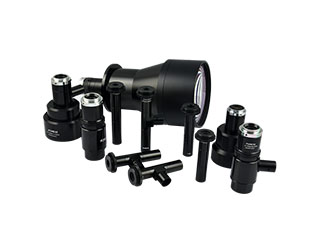
In precision manufacturing, automated inspection, electronics, and semiconductor industries, measurement accuracy and imaging stability are core factors determining production efficiency and product quality. Telecentric lenses serve as key optical components for eliminating parallax errors and ensuring high-definition imaging. As a leading domestic optical solutions provider, POMEAS leverages over a decade of optical R&D expertise to deliver the PMS-05HT110 telecentric lens. With its advantages of low distortion, high resolution, and broad adaptability, this lens has become the preferred choice for numerous industry clients.

I. Principle: Why are telecentric lenses more suitable for precision applications than standard lenses?

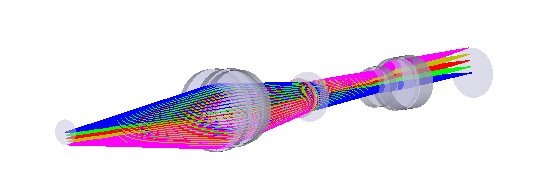
Conventional industrial lenses suffer from imaging scale shifts during inspection due to changes in object distance. For instance, when inspecting chip pins, even slight part movement causes the captured pin length to deviate, directly affecting measurement accuracy. The core advantage of telecentric lenses lies in their parallel light entry/exit design, which maintains consistent image size across a defined range of object movement. This fundamentally eliminates parallax errors.
Take the PMS-05HT110 high-resolution telecentric lens from POMEAS as an example. Utilizing high-transmittance optical glass and multi-layer coating technology, it not only minimizes light reflection loss but also controls image distortion rates far below industry averages. Whether inspecting minute electronic components or large-scale mechanical parts, it guarantees precision where what you see is what you measure, preventing increased product defect rates caused by optical errors.
II. Product Advantages: How to Adapt to Diverse Scenarios?
The value of a premium telecentric lens is realized through its practical advantages in real-world applications. The PMS-05HT110 from POMEAS addresses inspection challenges across diverse industries with precision-engineered design and flexible adaptability. Its core advantages include:

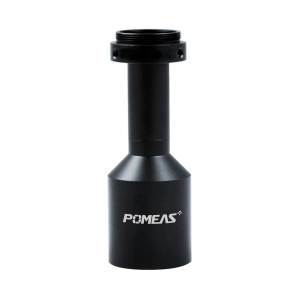
1. Strong Adaptability: Features a working distance compatible with most inspection platforms, eliminating frequent adjustments to equipment spacing. Supports inspection of various-sized workpieces including electronic components and mechanical parts. Also compatible with mainstream industrial cameras, reducing equipment upgrade costs without requiring additional camera replacements.
2. High-Definition Imaging: Delivers micron-level resolution for precise detection of minute details like chip pin spacing and gear tooth pitch. Its low-distortion design prevents dimensional misjudgment caused by image stretching, making it ideal for high-precision measurement scenarios.
3. Seamless Integration: Utilizes standard industrial interfaces with plug-and-play support, compatible with most automated inspection equipment. Simplifies integration processes and accelerates project implementation cycles. Its lightweight design enables dynamic inspection with robotic arms, preventing load issues caused by lens weight and expanding automation applications.
4. Environmental Resilience: Operates reliably in complex workshop environments spanning extreme temperatures. Maintains stable performance in diverse settings—from electronics cleanrooms to machining factories—without compromising inspection accuracy due to environmental factors.
III. Parameter Analysis: How to Adapt to Diverse Scenarios?
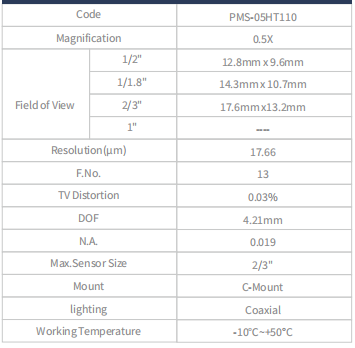
The value of a premium telecentric lens is realized through its key parameters in practical applications. The POMEAS PMS-05HT110 addresses inspection challenges across various industries with precisely tailored and flexibly adaptable parameter designs.
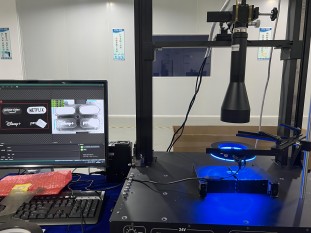
IV. Practical Case Studies

Product recommendation
TECHNICAL SOLUTION
MORE+You may also be interested in the following information
FREE CONSULTING SERVICE
Let’s help you to find the right solution for your project!
 ASK POMEAS
  PRICE INQUIRY
  REQUEST DEMO/TEST
  FREE TRIAL UNIT
  ACCURATE SELECTION
- APPICATION CASE
- RESOURCE CENTER
- DOWNLOAD CENTER
SOLUTIONS SUPPORT
- ZOOM LENS SELECTION TOOL
- TELECENTRIC LENS SELECTION TOOL
- FA LENS SELECTION TOOL
- ZOOM RATIO TABLE
- CERTIFIED MODEL
SELECTION TOOL
- WHY POMEAS
- FAQ
- PRIVACY POLICY
- TERMS OF USE
- DELIVERY & RETURN POLICY
CUSTOMER CARE
 ADDRESS
Add.:No.68, Yongwei Road, Baizhoubian, Dongcheng District, Dongguan, China,523000
CONTACT
 Tel:+ 86-0769-2266 0867
 Fax:+ 86-0769-2266 0867
 E-mail:marketing@pomeas.com

Wechat QR code

Software Copyright :2021SR0176001 抄袭必究, 技术支持:誉新源科技