


What does the “numerical aperture (NA)” of a point-spectrum confocal displacement sensor mean?
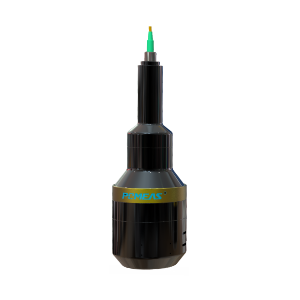
In the field of optical precision measurement, numerical aperture (NA) serves as the “visual acuity indicator” for optical systems, directly influencing a sensor's light capture capability, imaging resolution, and measurement accuracy. This dimensionless parameter not only determines the imaging quality of microscopes but also plays a pivotal role in industrial inspection, biomedical applications, and other scenarios. Take the POMEAS Spectral Confocal Sensor SFS-D8040 as an example. Its NA value of 0.31 enables it to achieve an ultimate precision of ±1.4μm in measuring apertures on glass substrates.

I. The Physical Nature of NA: The Geometry of the Light Cone
The numerical aperture (NA) is defined as the product of the medium's refractive index (n) and the half-sine of the aperture angle (sinα), i.e., NA = n · sinα. This formula reveals two core capabilities of an optical system:
1. Light Collection Capability: The aperture angle α determines the angular range of light that a lens can receive. A larger α results in higher light flux entering the system. For example, microscope objectives increase α by enlarging the effective diameter, while optical fibers control NA through the refractive index difference between the core and cladding.
2. Spatial Resolution: According to the Rayleigh criterion, the lateral resolution of an optical system is d = 0.61λ/NA (where λ is the wavelength). This implies that doubling the NA value nearly doubles the resolution, but at the cost of a sharp decrease in depth of field (DOF) proportional to the inverse of NA².

The POMEAS SFS-D8040 sensor features a numerical aperture (NA) of 0.31, achieving a theoretical resolution of approximately 0.8 μm at its operating wavelength of 405 nm. Its accompanying CCSVR1.0.2.4 software employs algorithmic optimization to surpass theoretical limits in actual measurement accuracy, reaching ±1.4 μm. This enhancement stems from the increased light intensity gain and improved signal-to-noise ratio delivered by the high NA.
II. Engineering Trade-offs Between High NA and Low NA
(1) High NA: The Price of Pursuing Ultimate Resolution
- Spot Size Compression: At NA=0.31, the SFS-D8040's spot diameter can be compressed to the micrometer level, enabling precise capture of minute variations at the edges of glass substrate apertures. However, when NA increases to 1.4, the spot diameter shrinks further to approximately 0.2μm, yet the working distance is reduced to only about 0.1mm.
- Depth of Field Sacrifice: The depth of focus in high NA systems is inversely proportional to NA². The SFS-D8040's ±20.2° beam angle corresponds to a measurement range of approximately 7mm. In contrast, ultra-high NA systems (e.g., NA=1.4) typically have a depth of focus under 1μm, imposing stringent flatness requirements on the measured object.
( 2 ) Low NA: A Pragmatic Compromise
- Tilt Tolerance: At NA=0.1, the system accepts ±5.7° tilt angles without significant loss of light intensity. This characteristic gives low-NA sensors an advantage in curved surface measurements, such as automotive engine block inspection scenarios.
- Extended Working Distance: The POMEAS SFS-D8040 achieves a minimum measurement distance of 40mm while maintaining an NA of 0.31 through optimized optical path design. Conventional sensors with equivalent NA typically have working distances under 20mm.
- Environmental Adaptability: Low NA systems are more sensitive to changes in medium refractive index. The SFS-D8040 employs automatic temperature compensation to control measurement errors caused by ambient temperature fluctuations within ±0.5μm. This design is particularly critical in industrial environments.
III. Engineering Application Boundaries of NA
(1) Microscopy Imaging Field
- Low NA (0.04–0.2): 4×/10× objectives for rapid screening of histological sections
- Medium NA (0.3–0.8): 40× objectives balancing resolution and depth of field
- High NA (0.9–1.4): 100× oil immersion objectives enabling subcellular structure observation
- Ultra-high NA (>1.4): Dedicated super-resolution objectives pushing beyond the diffraction limit
(2) Fiber Optic Communications Field
- Conventional OM2 fiber (NA=0.275) supports 1Gbps transmission over 550m.
- High-NA OM4 fiber (NA=0.22) extends the distance to 550m at 10Gbps.
- However, increased NA exacerbates modal dispersion, limiting single-mode fiber NA to typically below 0.14.
(3) Industrial Inspection Field
- The SFS-D8040 achieves a balance between resolution and depth of field in glass substrate measurements with its 0.31 NA.
- The higher-NA SFS-D8060 (NA=0.45) boosts resolution to 0.5μm but reduces the measurement range to 3mm.
- The low-NA SFS-D8020 (NA=0.15) focuses on wide-range curved surface measurements.
Product recommendation
TECHNICAL SOLUTION
MORE+You may also be interested in the following information
FREE CONSULTING SERVICE
Let’s help you to find the right solution for your project!

 ASK POMEAS
  PRICE INQUIRY
  REQUEST DEMO/TEST
  FREE TRIAL UNIT
  ACCURATE SELECTION
- APPICATION CASE
- RESOURCE CENTER
- DOWNLOAD CENTER
SOLUTIONS SUPPORT
- ZOOM LENS SELECTION TOOL
- TELECENTRIC LENS SELECTION TOOL
- FA LENS SELECTION TOOL
- ZOOM RATIO TABLE
- CERTIFIED MODEL
SELECTION TOOL
- WHY POMEAS
- FAQ
- PRIVACY POLICY
- TERMS OF USE
- DELIVERY & RETURN POLICY
CUSTOMER CARE
 ADDRESS
Add.:No.68, Chongwei Road, Baizhoubian, East district, Dongguan, China, 523000
CONTACT
 Tel:+ 86-0769-2266 0867
 Fax:+ 86-0769-2266 0867
 E-mail:marketing@pomeas.com

Wechat QR code

Software Copyright :2021SR0176001 抄袭必究, 技术支持:誉新源科技