


Differences Between 5-Megapixel Color Industrial Cameras and Monochrome Cameras
In industrial inspection scenarios, users often fall into a common misconception: assuming that a 5-megapixel color camera and a 5-megapixel monochrome camera should deliver identical detail performance. However, actual test data reveals that at the same resolution, monochrome cameras consistently outperform color cameras in key metrics such as edge sharpness and texture clarity.

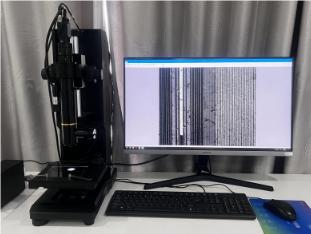
Black-and-White Industrial Camera Solution Effect

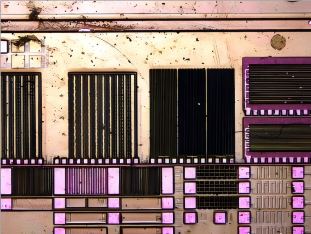
Color Industrial Camera Solution Effect
Color capture is achieved by covering the sensor surface with red, green, and blue filters, but each pixel can only receive a single color light signal. For example, in a 5-megapixel color camera, only approximately 1.67 million (red/blue) and 3.33 million (green) pixels directly sense light. The remaining pixels must “guess” the missing colors through interpolation algorithms. This mathematical estimation introduces blurring effects when processing high-contrast edges (e.g., metal scratches) or fine textures (e.g., fabric fibers), leading to detail loss. Experimental data shows that when detecting 0.01mm micro-defects, color cameras exhibit a 37% higher false detection rate than monochrome models.
In contrast, monochrome cameras directly capture the full spectrum of light, with each pixel independently recording light intensity. Eliminating color separation results in higher quantum efficiency and the capture of more effective signals. Their single-channel grayscale data (8-16 bits/pixel) also reduces computational load, enabling edge detection speeds three times faster than color cameras—ideal for high-speed production lines. Additionally, monochrome cameras typically offer a 2-3 stop higher dynamic range, delivering superior signal-to-noise ratio in low light and reduced overexposure in bright conditions. This provides distinct advantages for outdoor applications or inspections on reflective surfaces.
Selection Recommendations:
For color classification tasks (such as pharmaceutical sorting) or color difference inspection, choose a color camera;
For high-precision requirements like dimensional measurement or micro-defect detection, prioritize monochrome models.
In the future, new technologies such as quantum dot filters may overcome the limitations of Bayer arrays. However, in current industrial inspection applications, monochrome cameras remain the reliable choice for detailed reproduction.
Product recommendation
TECHNICAL SOLUTION
MORE+You may also be interested in the following information
FREE CONSULTING SERVICE
Let’s help you to find the right solution for your project!
 ASK POMEAS
  PRICE INQUIRY
  REQUEST DEMO/TEST
  FREE TRIAL UNIT
  ACCURATE SELECTION
- APPICATION CASE
- RESOURCE CENTER
- DOWNLOAD CENTER
SOLUTIONS SUPPORT
- ZOOM LENS SELECTION TOOL
- TELECENTRIC LENS SELECTION TOOL
- FA LENS SELECTION TOOL
- ZOOM RATIO TABLE
- CERTIFIED MODEL
SELECTION TOOL
- WHY POMEAS
- FAQ
- PRIVACY POLICY
- TERMS OF USE
- DELIVERY & RETURN POLICY
CUSTOMER CARE
 ADDRESS
Add.:No.68, Chongwei Road, Baizhoubian, East district, Dongguan, China, 523000
CONTACT
 Tel:+ 86-0769-2266 0867
 Fax:+ 86-0769-2266 0867
 E-mail:marketing@pomeas.com

Wechat QR code

Software Copyright :2021SR0176001 抄袭必究, 技术支持:誉新源科技