


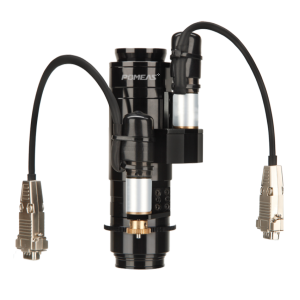
ZOOM LENSes are commonly used optical components in industrial vision inspection. At a fixed working distance, they continuously adjust the magnification by moving the internal lens groups, eliminating the need to change lenses and allowing for both wide-angle viewing and detailed magnification. They are divided into two main categories: manual and motorized.。

What is a Manual Zoom LENS?

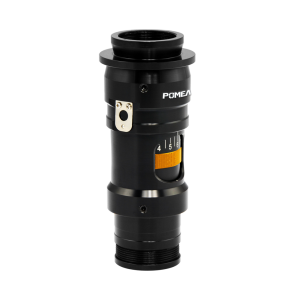
Manual zoom relies on manually rotating the adjustment ring to change the magnification; once calibrated, it is typically set to a fixed magnification. With a simple structure, lower cost, and good stability, it is commonly used in laboratory spot checks, benchtop testing equipment, and visual screening of samples. It is suitable for offline inspection of small batches of samples with multiple models in scenarios where automatic magnification switching via software is not required.
What is a Motorized Zoom LENS?

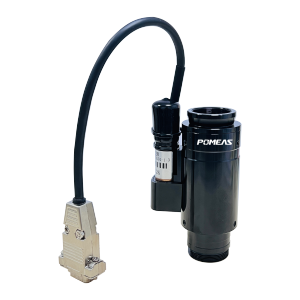
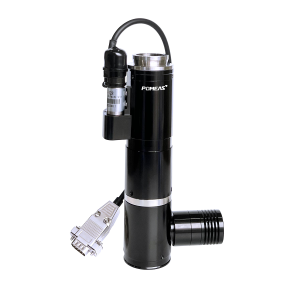
Motorized zoom is a type of motorized magnification system that uses a built-in motor to drive the lens assembly. Magnification changes can be triggered via software, a controller, or signal commands, and the system supports integration with vision software and PLCs. In automated production lines, the system can automatically perform low-magnification panoramic positioning and high-magnification inspection for defect detection. It is suitable for continuous in-line inspection, enables automatic switching between multiple magnification levels, and offers high repeatability in positioning accuracy. The drawbacks are a more complex structure and higher costs compared to manual models.
Magnification refers to the optical magnification factor, and the magnification range determines the lens’s field of view and maximum magnification limit. The lower the magnification value, the larger the field of view; the higher the magnification, the greater the magnification capability, allowing for the observation of finer details.
0.7x–4.5x is the industry’s mainstream magnification range, offering a moderate magnification ratio, balanced optical imaging, and stable image quality throughout the entire range. It is commonly used for routine electronic component inspection, PCB visual inspection, and dimensional and defect detection of metal parts, and is compatible with in-line image measurement equipment and video microscopes. It balances wide-field positioning with routine detail observation, making it the preferred choice for most standardized visual inspection solutions.
The 0.58x–7.5x range offers a wider zoom range, with a broader field of view at the lowest magnification and stronger magnification capability at the highest magnification. It is suitable for scenarios requiring both wide-area scanning and observation of ultra-fine defects, such as the inspection of precision terminals, semiconductor packages, and micro-plastic parts. Users can first quickly scan the entire workpiece at low magnification, then switch to high magnification to inspect fine features such as scratches, pin deformation, and minute silk-screen printing. It is commonly used in high-precision microscopic inspection equipment.
Conclusion:
For offline spot checks with limited budgets, choose manual ZOOM LENSES; for automated production lines requiring the system to automatically switch magnification levels, choose motorized ZOOM LENSES. For routine inspections, prioritize the 0.7x–4.5x range; for workpieces with a wide range of sizes that require observation of micron-level defects, consider the 0.58x–7.5x range.
TECHNICAL SOLUTION
MORE+You may also be interested in the following information
FREE CONSULTING SERVICE
Let’s help you to find the right solution for your project!
 ASK POMEAS
  PRICE INQUIRY
  REQUEST DEMO/TEST
  FREE TRIAL UNIT
  ACCURATE SELECTION
- APPICATION CASE
- RESOURCE CENTER
- DOWNLOAD CENTER
SOLUTIONS SUPPORT
- ZOOM LENS SELECTION TOOL
- TELECENTRIC LENS SELECTION TOOL
- FA LENS SELECTION TOOL
- ZOOM RATIO TABLE
- CERTIFIED MODEL
SELECTION TOOL
- WHY POMEAS
- FAQ
- PRIVACY POLICY
- TERMS OF USE
- DELIVERY & RETURN POLICY
CUSTOMER CARE
 ADDRESS
Add.:No.68, Yongwei Road, Baizhoubian, Dongcheng District, Dongguan, China,523000
CONTACT
 Tel:+ 86-0769-2266 0867
 Fax:+ 86-0769-2266 0867
 E-mail:marketing@pomeas.com

Wechat QR code

Software Copyright :2021SR0176001 抄袭必究, 技术支持:誉新源科技