


What is the role of industrial cameras in SMT component inspection?
How are the densely packed small components on smartphone motherboards and smartwatch circuit boards inspected so quickly? This is made possible by SMT (Surface Mount Technology) inspection equipment, and industrial cameras serve as the “eyes” of such equipment. Their role can be summarized as follows: they quickly capture high-resolution images to help the inspection equipment identify and assess component quality, including dimensions, cosmetic defects, and positioning accuracy.

I. Why Are Industrial Cameras Needed for SMT Inspection?
SMT production lines are used to mount components such as resistors, capacitors, and chips onto circuit boards. Because the components are small and the mounting cycle is fast, prolonged observation with a magnifying glass can cause eye strain, and it is difficult to maintain consistent judgment criteria. Industrial cameras convert optical images into digital images, allowing algorithms to reliably analyze each component. Simply put, they do not directly “fix” the components, but rather provide inspection equipment with a reliable source of data.
II. Capturing High-Resolution Images Quickly: It All Comes Down to “Matching”
High resolution does not mean that a higher pixel count is always better. For SMT inspection, what matters is whether the actual size of the component corresponding to each pixel is sufficiently small. For example, when inspecting small packages such as 0402 and 0201, pixel accuracy typically needs to be in the range of tens of micrometers to ten micrometers so that features such as the component body, leads, and characters fall across multiple pixels, facilitating algorithm-based analysis. At the same time, the production line cannot stop to wait for the camera to take a picture; industrial cameras must work in conjunction with lighting, lenses, and transmission interfaces to capture images within the production cycle. Only when images are both clear and timely do subsequent inspections hold meaningful value.
III. How Inspection Equipment Uses Images to Assess Quality
The images provided by industrial cameras primarily support three types of inspections.
Dimension Inspection: Calculate actual dimensions—such as component length and width, lead width, and placement offset—through pixel calibration.
Visual defect detection: Identifies anomalies such as missing components, damage, tombstoning, bridging, reversed polarity, and blurred characters.
Positioning accuracy assessment: Identifies component centers and angles prior to placement, and checks for offset and rotation after placement, providing feedback for motion control. These assessments are based on clear, quantifiable image features.
IV. The Camera Does Not Work on Its Own
For an industrial camera to function effectively, it relies on the coordinated interaction of the light source, lens, interface, and algorithms. The light source makes features such as pins, solder joints, and characters visible; the lens determines the field of view and imaging resolution; the interface and transmission method affect whether image data can reach the processing unit in a timely manner; and the algorithms convert the images into conclusions regarding dimensions, defects, and positions. If any one of these components is out of sync, it can affect the inspection results. Therefore, when discussing the role of industrial cameras, they cannot be viewed in isolation from the imaging system.
V. Selection Approach: Based on Production Line Requirements

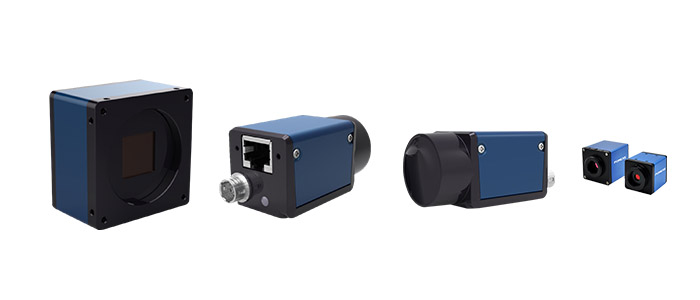
For those looking into SMT inspection solutions, it’s best to start by considering two questions: What is the range of component sizes on the production line, and how fast does the inspection cycle need to be? Based on these factors, determine the camera’s resolution, frame rate, interface, and shutter mode, while also considering installation space and depth-of-field requirements. A camera with high pixel count but a frame rate that cannot keep up with the production line, or one with a fast frame rate but insufficient image clarity, will struggle to meet actual inspection needs. Matching the production line’s requirements is more meaningful than simply pursuing high specifications.
Product recommendation
TECHNICAL SOLUTION
MORE+You may also be interested in the following information
FREE CONSULTING SERVICE
Let’s help you to find the right solution for your project!
 ASK POMEAS
 PRICE INQUIRY
 REQUEST DEMO/TEST
 FREE TRIAL UNIT
 ACCURATE SELECTION

- APPICATION CASE
- RESOURCE CENTER
- DOWNLOAD CENTER
SOLUTIONS SUPPORT
- ZOOM LENS SELECTION TOOL
- TELECENTRIC LENS SELECTION TOOL
- FA LENS SELECTION TOOL
- ZOOM RATIO TABLE
- CERTIFIED MODEL
SELECTION TOOL
- WHY POMEAS
- FAQ
- PRIVACY POLICY
- TERMS OF USE
- DELIVERY & RETURN POLICY
CUSTOMER CARE
 ADDRESS
Add.:No.68, Yongwei Road, Baizhoubian, Dongcheng District, Dongguan, China,523000
CONTACT
 Tel:+ 86-0769-2266 0867
 Fax:+ 86-0769-2266 0867
 E-mail:marketing@pomeas.com

Wechat QR code

Software Copyright :2021SR0176001 抄袭必究, 技术支持:誉新源科技