


As a core optical component in the field of industrial precision inspection, telecentric lenses often confuse engineers who are new to machine vision due to their various classifications. In fact, the classification of telecentric lenses is entirely based on actual inspection requirements; the core capabilities and applicable scenarios of different types are very distinct. Choosing the right one can directly solve precision challenges that standard lenses cannot handle.

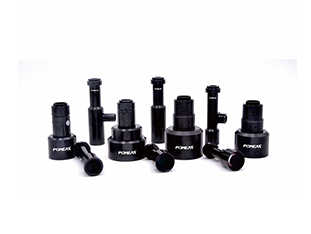
Objective-side Telecentric Lens
The core design of this type of lens involves placing the aperture diaphragm on the image-side focal plane of the optical system, allowing the principal rays on the object side to travel completely parallel to the optical axis. Its most significant function is to eliminate, at the source, measurement errors caused by focusing inaccuracies.

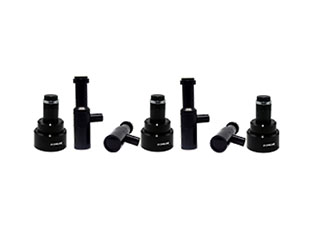
In actual production scenarios, even slight vertical shifts in the object being measured or minor vibrations in the conveyor belt can easily cause standard lenses to produce images that fluctuate in size due to changes in object distance. In contrast, object-side telecentric lenses ensure that the magnification of the image remains stable within a certain depth range, regardless of minor variations in the object’s position. It is particularly well-suited for applications involving objects of modest thickness but with low tolerance for variations in object distance, such as dimensional screening of standard flat workpieces and preliminary inspection for surface defects. It is the most widely used basic type on industrial production lines.
Image-side Telecentric Lens
Unlike the optical path design of the object-side focal plane lens, this design places the aperture diaphragm at the object-side focal plane of the optical system, allowing the principal rays on the image side to propagate parallel to the optical axis. Its primary purpose is to eliminate measurement errors caused by misalignment of the image side.

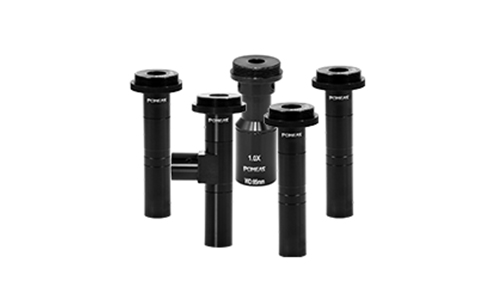
In many imaging systems, camera image sensors are occasionally installed at an angle or out of focus, which can cause significant imaging aberrations with standard lenses. Anastatic lenses, however, can prevent measurement errors caused by such issues. These lenses are primarily used in projection imaging and specific optical path calibration applications, often serving as auxiliary components in conjunction with other optical systems to ensure consistent accuracy in the downstream image acquisition process.
Bilateral Telecentric Lens
This is what is commonly referred to as a double-telecentric lens; it combines the optical advantages of both object-side and image-side telecentricity, with the principal rays on both sides traveling parallel to the optical axis.

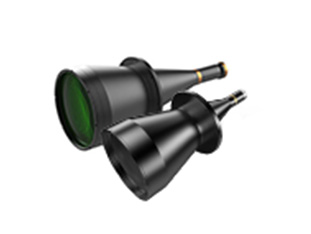
Compared to single-element telecentric designs, it offers more comprehensive advantages: not only does it compensate for magnification variations caused by fluctuations in object distance, but it also accommodates mounting tolerances on the camera side while keeping distortion to an extremely low level, virtually eliminating the “near-large, far-small” perspective error commonly found in standard lenses. Even when the object being measured is not in the same plane or has a multi-layered structure, it ensures imaging consistency across the entire field of view, making it the preferred choice for high-precision dimensional measurement and defect detection in complex structures.

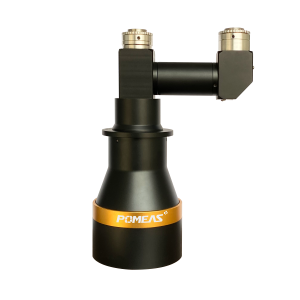
There is no absolute superiority or inferiority among different types of telecentric lenses; the key is to match them to your specific inspection needs. For simple planar inspections, object-side telecentric lenses can get the job done with a better cost-performance ratio; however, when it comes to micrometer-level precision dimensional measurements or simultaneous imaging of workpieces across multiple planes, dual-side telecentric lenses play an irreplaceable role. By understanding the core differences among these three types of lenses, you can avoid many common accuracy pitfalls during the selection process.
Product recommendation
TECHNICAL SOLUTION
MORE+You may also be interested in the following information
FREE CONSULTING SERVICE
Let’s help you to find the right solution for your project!
 ASK POMEAS
 PRICE INQUIRY
 REQUEST DEMO/TEST
 FREE TRIAL UNIT
 ACCURATE SELECTION

- APPICATION CASE
- RESOURCE CENTER
- DOWNLOAD CENTER
SOLUTIONS SUPPORT
- ZOOM LENS SELECTION TOOL
- TELECENTRIC LENS SELECTION TOOL
- FA LENS SELECTION TOOL
- ZOOM RATIO TABLE
- CERTIFIED MODEL
SELECTION TOOL
- WHY POMEAS
- FAQ
- PRIVACY POLICY
- TERMS OF USE
- DELIVERY & RETURN POLICY
CUSTOMER CARE
 ADDRESS
Add.:No.68, Yongwei Road, Baizhoubian, Dongcheng District, Dongguan, China,523000
CONTACT
 Tel:+ 86-0769-2266 0867
 Fax:+ 86-0769-2266 0867
 E-mail:marketing@pomeas.com

Wechat QR code

Software Copyright :2021SR0176001 抄袭必究, 技术支持:誉新源科技