


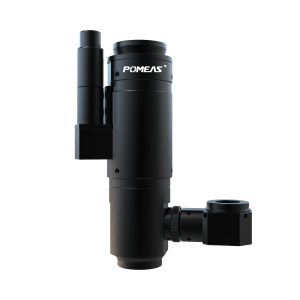
The operating principle of an electric zoom microscope objective can be summarized as follows: a motor drives the zoom group (and sometimes the compensation group or focusing group) within the optical system to move along a predetermined trajectory, thereby altering the combined focal length and the intermediate image magnification, which in turn continuously changes the magnification; at the same time, the position of the image plane, co-focusing, and working distance are kept essentially stable through the compensation group and closed-loop control.

Principles of Optical Zoom
1. The interior of a microscope objective typically consists of a fixed group, a zoom group, and a compensation group.
2. Moving the zoom group changes the combined focal length and intermediate image magnification of the entire objective, thereby varying the magnification.
3. Moving only the zoom group causes image plane drift and defocusing; therefore, the compensation group must move in tandem according to a specific curve to keep the image plane at the focal plane of the detector or eyepiece, thereby achieving “co-focal” zoom.
4. The magnification can be roughly understood as being related to the zoom group’s magnification: as the zoom group’s magnification changes, the system’s total magnification changes accordingly.
Electric Drive
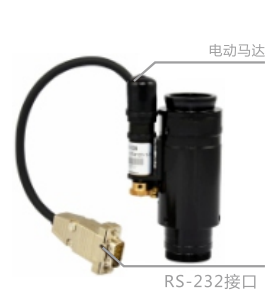
1. Use stepper motors, servo motors, DC motors, or voice-coil motors to drive the lens group via transmission mechanisms such as lead screws, gears, cams, and guide rails.
2. Some systems use mechanical cams to ensure synchronized movement between the zoom group and the compensation group, with the motor driving only the cam; others use dual or multiple motors for separate drive, with software interpolating the synchronized motion curve.
Monitoring and Closed-Loop Control
1. Detect the position of the lens assembly using encoders, Hall sensors, limit switches, and other devices.
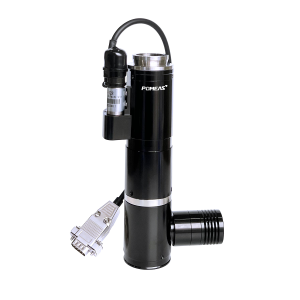
2. The control board receives commands from the host computer or handheld controller (e.g., RS485, CAN, serial port, USB, etc.), drives the motor to the target magnification position, and provides feedback on the position status.
3. Closed-loop control reduces magnification errors caused by backlash, temperature drift, and load variations.
Interoperability Features
1. When changing the magnification, the aperture, illumination intensity, and focus compensation are typically adjusted in tandem to maintain brightness, depth of field, and image sharpness.
2. In industrial video microscopes, these functions are also often integrated with the camera, autofocus system, and illumination controller.
An electric zoom microscope objective replaces the linked optical structure of a traditional manual zoom objective—consisting of a “zoom group + compensation group”—with a motor-driven system equipped with position feedback control, thereby maintaining a stable image plane and image sharpness when changing the magnification.
Product recommendation


TECHNICAL SOLUTION
MORE+You may also be interested in the following information
FREE CONSULTING SERVICE
Let’s help you to find the right solution for your project!
 ASK POMEAS
 PRICE INQUIRY
 REQUEST DEMO/TEST
 FREE TRIAL UNIT
 ACCURATE SELECTION

- APPICATION CASE
- RESOURCE CENTER
- DOWNLOAD CENTER
SOLUTIONS SUPPORT
- ZOOM LENS SELECTION TOOL
- TELECENTRIC LENS SELECTION TOOL
- FA LENS SELECTION TOOL
- ZOOM RATIO TABLE
- CERTIFIED MODEL
SELECTION TOOL
- WHY POMEAS
- FAQ
- PRIVACY POLICY
- TERMS OF USE
- DELIVERY & RETURN POLICY
CUSTOMER CARE
 ADDRESS
Add.:No.68, Yongwei Road, Baizhoubian, Dongcheng District, Dongguan, China,523000
CONTACT
 Tel:+ 86-0769-2266 0867
 Fax:+ 86-0769-2266 0867
 E-mail:marketing@pomeas.com

Wechat QR code

Software Copyright :2021SR0176001 抄袭必究, 技术支持:誉新源科技