


What are the main applications of motorized zoom microscope objectives?
The primary applications of motorized zoom microscope objectives are in situations that require continuous magnification adjustment, remote or programmable control, co-focal observation, and integration with cameras, lighting systems, and motion platforms.

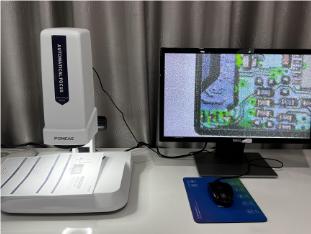
Industrial Online Inspection and AOI
1. Inspection of PCBs/PCBAs, connectors, FPCs, solder joints, pins, silk screen markings, scratches, burrs, and cracks.
2. At each station, the system first locates the target at low magnification, then examines details at high magnification; the motorized zoom allows for programmable magnification switching, making it suitable for automated inspection lines.
Semiconductor and Microelectronics Manufacturing
1. Wafer surfaces, chip packaging, wire bonding, MEMS, microbumps, and alignment for dicing, die attachment, and dispensing.
2. Requires a combination of high-magnification detailed observation and low-magnification wide-field positioning, and often involves the coordinated operation of motion stages, cameras, and light sources.
Precision Electronic Assembly and Repair
1. Mobile phone/camera modules, connector pins, micro motors, sensor assembly, and wire bonding rework.
2. Operators can perform tasks at low magnification and inspect at high magnification; the motorized zoom reduces the time required for manual focusing and changing objectives.
Precision Machinery and Materials Testing
1. Observation of watch components, jewelry, knife edges, fibers, coatings, metal fracture surfaces, metallographic structures, and surface roughness/defects.
2. Typically equipped with a metallographic or stereo optical path for spot checks in laboratories and on production lines.
New Energy and Battery Manufacturing
1. Inspection of battery electrodes, tab welding, separators, cell appearance, connectors, welds, and coating defects.
2. The production line requires a high cycle rate; an electric zoom function facilitates rapid magnification changes between different workstations.
Biomedical and Clinical Microscopy
1. Surgical microscopes, dental/ophthalmic operating microscopes, pathology slide screening, cell/tissue observation, and in vivo small animal imaging.
2. Motorized zoom and motorized focus can be controlled via foot pedal or hand control, maintaining continuous magnification and proper focus in the surgical field.
Laboratory Automation and Microscopy Imaging
1. Cell counting, organoid/zebrafish observation, microfluidics, material microscopy, and microplate scanning.
2. Integrates with motorized stages, cameras, and autofocus systems to enable programmed image acquisition at multiple magnifications.
Machine Vision and Micro-Assembly
1. Micro-assembly, laser processing alignment, dispensing, bonding, micro- and nano-manipulation, and precision measurement.
2. Motorized zoom lenses can be used as variable-magnification vision lenses for low-magnification scanning and high-magnification measurement.
Criminal Investigation, Document Examination, and Educational Demonstrations
1. Document examination, trace evidence analysis, fiber analysis, and jewelry appraisal;
2. Distance learning, multi-user demonstrations, and video microscopy. Requires continuous zoom, simultaneous focusing, and image output to facilitate recording and sharing.

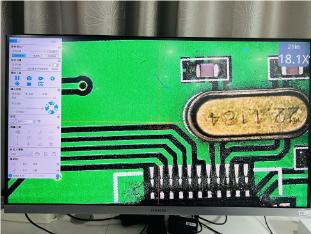
The most typical applications for motorized zoom microscope objectives include: industrial video microscopes/AOI, semiconductor and electronics manufacturing, precision assembly and repair, biomedical surgery and laboratory automation, and machine vision-based micro-assembly. Their core value lies in “locating targets at low magnification, examining details at high magnification, automated switching, maintaining co-focusing, and ease of integration.”
Product recommendation
TECHNICAL SOLUTION
MORE+You may also be interested in the following information
FREE CONSULTING SERVICE
Let’s help you to find the right solution for your project!
 ASK POMEAS
 PRICE INQUIRY
 REQUEST DEMO/TEST
 FREE TRIAL UNIT
 ACCURATE SELECTION

- APPICATION CASE
- RESOURCE CENTER
- DOWNLOAD CENTER
SOLUTIONS SUPPORT
- ZOOM LENS SELECTION TOOL
- TELECENTRIC LENS SELECTION TOOL
- FA LENS SELECTION TOOL
- ZOOM RATIO TABLE
- CERTIFIED MODEL
SELECTION TOOL
- WHY POMEAS
- FAQ
- PRIVACY POLICY
- TERMS OF USE
- DELIVERY & RETURN POLICY
CUSTOMER CARE
 ADDRESS
Add.:No.68, Yongwei Road, Baizhoubian, Dongcheng District, Dongguan, China,523000
CONTACT
 Tel:+ 86-0769-2266 0867
 Fax:+ 86-0769-2266 0867
 E-mail:marketing@pomeas.com

Wechat QR code

Software Copyright :2021SR0176001 抄袭必究, 技术支持:誉新源科技