


What is a 2D line laser sensor?
A 2D line laser sensor, sometimes referred to as a laser displacement sensor or profile scanning sensor, focuses primarily on a “single line” of an object, as the name suggests.
It works by expanding a laser beam into a static laser line projected onto the surface of an object, then using a CMOS camera to capture the distortion of this line from another angle. Through optical triangulation, the sensor can accurately calculate the width (X-axis) and height (Z-axis) data for every point along the laser line.
Key Features: Contour Scanning and Dimensional Measurement

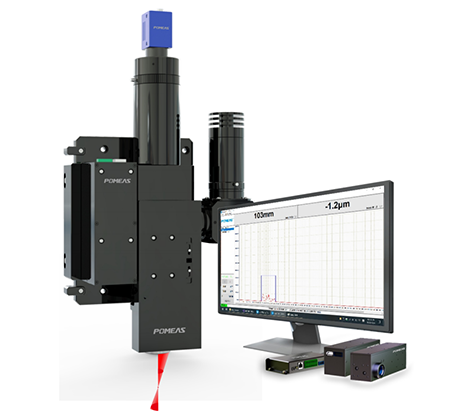
A 2D line laser primarily outputs two-dimensional contour data. It can accurately map the shape of an object at a specific cross-section. In industrial settings, it is often used to address the following measurement challenges:
1. Contour and Geometric Comparison: Verifies whether the edges, chamfers, and radii of precision-machined parts match the standard CAD drawings.
2. Critical Dimension Measurement: Measure the width, height, and step height of an object. Examples include flatness inspection of smartphone frames and thickness monitoring of battery plates.
3. In-line Defect Detection: For instance, after an adhesive dispensing robot applies glue, a 2D laser can quickly scan the width and height of the glue bead to determine if there are any breaks or sagging.
Product recommendation
TECHNICAL SOLUTION
MORE+You may also be interested in the following information
FREE CONSULTING SERVICE
Let’s help you to find the right solution for your project!

 ASK POMEAS
  PRICE INQUIRY
  REQUEST DEMO/TEST
  FREE TRIAL UNIT
  ACCURATE SELECTION
- APPICATION CASE
- RESOURCE CENTER
- DOWNLOAD CENTER
SOLUTIONS SUPPORT
- ZOOM LENS SELECTION TOOL
- TELECENTRIC LENS SELECTION TOOL
- FA LENS SELECTION TOOL
- ZOOM RATIO TABLE
- CERTIFIED MODEL
SELECTION TOOL
- WHY POMEAS
- FAQ
- PRIVACY POLICY
- TERMS OF USE
- DELIVERY & RETURN POLICY
CUSTOMER CARE
 ADDRESS
Add.:No.68, Yongwei Road, Baizhoubian, Dongcheng District, Dongguan, China,523000
CONTACT
 Tel:+ 86-0769-2266 0867
 Fax:+ 86-0769-2266 0867
 E-mail:marketing@pomeas.com

Wechat QR code

Software Copyright :2021SR0176001 抄袭必究, 技术支持:誉新源科技