


What are the typical applications for double-telecentric measurement lenses?
1. High-Precision Measurement of Mechanical Parts
-
Typical Applications: Precision shaft components, gear pitch, thread profiles, and contour dimensions of precision stamped parts.
-
Solves the following challenge: Conventional lenses produce ghosting caused by reflections from chamfers when capturing the edges of cylindrical objects. Dual telecentric lenses clearly define edge boundaries, enabling micrometer-level 2D dimensional measurement.
2. Electronic Components and Semiconductor Packaging
-
Typical Applications: BGA (Ball Grid Array) solder ball diameter/coplanarity inspection, chip lead flatness, wafer saw kerf width, and MEMS (Micro-Electro-Mechanical Systems) structural dimensions.
-
Addressing Challenges: When high-density leads exhibit slight variations in height within the depth of field, standard lenses produce an “enlarged near, reduced far” effect that leads to misjudgments; dual telecentric lenses ensure that the image size of all leads remains completely consistent.
3. Screen and Panel Testing (LCD/OLED)
-
Typical Applications: Locating dead pixels and Mura (brightness unevenness) on smartphone screens, calculating pixel aperture ratio, and verifying filter alignment accuracy.
-
Key Benefits: During wide-field-of-view stitching measurements, distortion at the edges and center is minimal (typically <0.1%), ensuring that pixels at the screen edges are not captured as “warped trapezoids.”
4. Laser Processing and Lithographic Alignment
-
Typical Applications: Film alignment for PCB exposure machines, screen printing alignment for solar cells, and vision-guided wafer probe stations.
-
Key Benefits: With a long working distance and a lens that emits parallel light, even slight defocusing of the image plane does not affect the imaging position, making it ideal for dynamic applications requiring vertical alignment.
5. Research and Optical Metrology
-
Typical Applications: Strain gauge deformation tracking in material tensile testing, droplet contact angle measurement, and channel width calibration in microfluidic chips.
-
Key Benefits: Ultra-high telecentricity ensures that the absolute position of a moving object remains stable during tracking, unaffected by changes in depth of field.
6. 3D Reconstruction and Structured Light Projection
-
Typical Applications: Projection optical paths for high-precision 3D profilometers and fringe projection measurements.
-
Addressing Key Challenges: Image-field telecentricity ensures that fringes remain parallel after passing through the lens, preventing distortion caused by lens aberrations—a critical factor for phase calculations.
When is it not recommended to use a double telecentric lens?

-
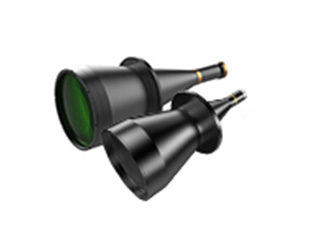
Measuring large objects: The lens’s entrance pupil diameter must be larger than the object’s dimensions. To measure an object 200 mm wide, a lens with a diameter of 200 mm or more is required, which is extremely costly and bulky.
-
For applications requiring only rough character recognition or presence/absence detection: The cost is significantly higher than that of FA industrial fixed-focus lenses.
Product recommendation
TECHNICAL SOLUTION
MORE+You may also be interested in the following information
FREE CONSULTING SERVICE
Let’s help you to find the right solution for your project!
 ASK POMEAS
  PRICE INQUIRY
  REQUEST DEMO/TEST
  FREE TRIAL UNIT
  ACCURATE SELECTION
- APPICATION CASE
- RESOURCE CENTER
- DOWNLOAD CENTER
SOLUTIONS SUPPORT
- ZOOM LENS SELECTION TOOL
- TELECENTRIC LENS SELECTION TOOL
- FA LENS SELECTION TOOL
- ZOOM RATIO TABLE
- CERTIFIED MODEL
SELECTION TOOL
- WHY POMEAS
- FAQ
- PRIVACY POLICY
- TERMS OF USE
- DELIVERY & RETURN POLICY
CUSTOMER CARE
 ADDRESS
Add.:No.68, Yongwei Road, Baizhoubian, Dongcheng District, Dongguan, China,523000
CONTACT
 Tel:+ 86-0769-2266 0867
 Fax:+ 86-0769-2266 0867
 E-mail:marketing@pomeas.com

Wechat QR code

Software Copyright :2021SR0176001 抄袭必究, 技术支持:誉新源科技