


In the field of modern industrial automation, where the pursuit of ultimate precision and stability is paramount, telecentric lenses—thanks to their unique optical design—have overcome the inherent limitations of conventional lenses, making them the preferred choice for applications such as high-precision dimensional measurement, positioning and defect detection.

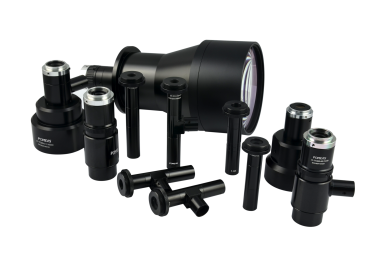
I: Characteristics of Telephoto Lenses
The key feature of a telecentric lens lies in its specialised optical design (object-side telecentric or bilateral telecentric), which provides the following significant advantages, meeting the demanding requirements of industrial inspection:
1.1 Zero perspective distortion: The most fundamental and important characteristic of a telecentric lens is zero perspective distortion. Regardless of how far an object is from the lens (within the depth of field), the size of its image on the image sensor remains constant.
1.2 Addressing Key Challenges: This completely eliminates the ‘near-large, far-small’ perspective error caused by changes in viewing angle and object height, which is typical of conventional lenses. For objects with varying heights or uneven surfaces (such as stepped components, cylinders or spheres), measurement results remain unaffected by slight changes in the object’s position or orientation, ensuring the absolute accuracy and repeatability of measurement data.
2.1 High-Precision Dimensional Measurement: Zero perspective error enables dimensional measurement with sub-pixel or even higher precision.
2.2 Key Benefits: In fields with extremely stringent dimensional tolerance requirements—such as semiconductor packaging, precision components and electronic components (e.g. connectors and PCBs)—telecentric lenses form the cornerstone for achieving micrometre- or even nanometre-level precision measurements.
3.1 Extremely Low Distortion: Telecentric lenses are typically precision-engineered and manufactured to exhibit very low optical distortion (such as barrel distortion and pincushion distortion) across the entire field of view.
3.2 Measurement Reliability: The extremely low distortion ensures that the geometry of the image at the edges is highly consistent with that at the centre. This is crucial for wide-field-of-view inspection or applications requiring high-precision positioning across the entire field of view, as it prevents measurement errors caused by distortion in the lens itself.
4.1 Large Depth of Field: Telecentric lenses typically have a large depth of field.
4.2 Ease of Use: This means that the object under inspection can be moved, or the lens can be repositioned, within a certain range whilst still maintaining a clear image of the target object. This reduces the stringent requirements for mechanical positioning accuracy and enhances the robustness and adaptability of the inspection system, making it particularly suitable for inspecting objects with a certain thickness or uneven surfaces.
5.1 Parallel optical path design: Telecentric lenses employ a design with parallel or nearly parallel principal rays (object-side telecentric: principal rays enter the lens parallel to the optical axis; bilateral telecentric: both the entrance and exit pupils are at infinity).
5.2 Performance Guarantee: This design provides the physical basis for eliminating perspective errors and achieving high precision and low distortion, ensuring that light passes through the edges of the object under inspection at a near-perpendicular angle, thereby yielding a clear contour image.
II. Applications of Telecentric Lenses
1. Precision dimensional measurement and tolerance inspection: Mobile phone and computer components (cases, buttons, ports); connector pin pitch and coplanarity; precision gear and bearing dimensions; medical device components; critical dimensions of injection-moulded parts; glass cover plate thickness; etc.
2. Semiconductor and electronics manufacturing: Wafer defect inspection; chip packaging (measurement of BGA solder ball coplanarity and diameter, gold wire bonding inspection); LED die size and electrode inspection; PCB trace width and spacing; component placement accuracy (SMT) inspection
3. 3C Electronics Industry: Display module (LCD/OLED) defect inspection (bright spots, dark spots, scratches, foreign objects); camera module (lens positional accuracy, VCM spring inspection); dimensional and geometric tolerance measurement of precision structural components (mid-frames, card holders)
4. Automotive component inspection: dimensional and morphological inspection of precision engine parts (e.g. fuel injectors, piston rings); gear tooth profile and meshing inspection; dimensional and defect inspection of seals; dimensional and positional accuracy of connector terminals
5. Research and high-end manufacturing: Micro-Electro-Mechanical Systems (MEMS) inspection; biomedical microscopic imaging and measurement; surface inspection and dimensional measurement of optical components (lenses, prisms)
Product recommendation
TECHNICAL SOLUTION
MORE+You may also be interested in the following information
FREE CONSULTING SERVICE
Let’s help you to find the right solution for your project!
 ASK POMEAS
  PRICE INQUIRY
  REQUEST DEMO/TEST
  FREE TRIAL UNIT
  ACCURATE SELECTION
- APPICATION CASE
- RESOURCE CENTER
- DOWNLOAD CENTER
SOLUTIONS SUPPORT
- ZOOM LENS SELECTION TOOL
- TELECENTRIC LENS SELECTION TOOL
- FA LENS SELECTION TOOL
- ZOOM RATIO TABLE
- CERTIFIED MODEL
SELECTION TOOL
- WHY POMEAS
- FAQ
- PRIVACY POLICY
- TERMS OF USE
- DELIVERY & RETURN POLICY
CUSTOMER CARE
 ADDRESS
Add.:No.68, Yongwei Road, Baizhoubian, Dongcheng District, Dongguan, China,523000
CONTACT
 Tel:+ 86-0769-2266 0867
 Fax:+ 86-0769-2266 0867
 E-mail:marketing@pomeas.com

Wechat QR code

Software Copyright :2021SR0176001 抄袭必究, 技术支持:誉新源科技