


Multi-sensor measurement system | Combining vision and laser technology
As the precision manufacturing industry continues to evolve towards miniaturisation, increasing complexity and tighter tolerances, the limitations of single-function inspection equipment are becoming increasingly apparent.
1. Purely two-dimensional imaging equipment can only capture planar contours and is unable to obtain three-dimensional data such as height, step height and flatness;
2. Line laser sensors excel at height scanning but struggle to rapidly measure small apertures, spacing, curvature and other planar dimensions in batch production;
3. Traditional contact-type probes offer stable measurement accuracy but are slow and highly prone to scratching flexible or ultra-thin workpieces. Furthermore, the use of these three types of equipment on separate production lines results in multiple cost inefficiencies, including equipment procurement, space requirements, the need to operate multiple software packages, and a lack of data interoperability.

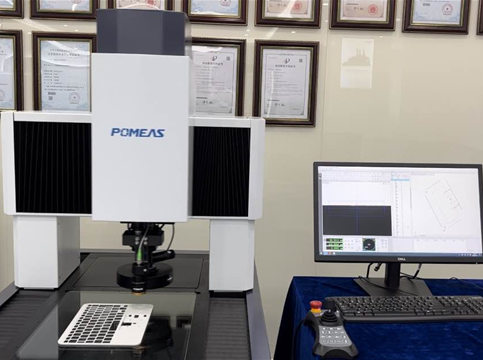
The multi-sensor measurement system, centred on multi-sensor fusion technology, integrates high-resolution vision modules, line laser profilometry, precision contact probes and confocal spectral sensing onto a single motion platform. Utilising a five-axis composite motion structure, it enables seamless switching between sensors and synchronised data acquisition, truly enabling a single device to cover all measurement requirements—including 2D planar dimensions, 3D topography, microscopic height differences, surface profile, and minute geometric and positional tolerances—thereby replacing traditional solutions involving multiple measurement devices.
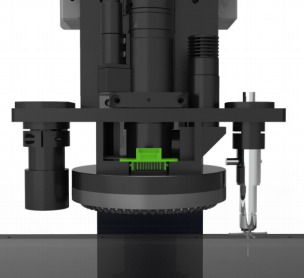
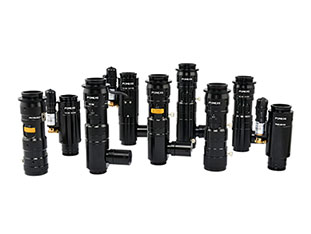
At the hardware level, it is equipped with a continuously variable optical module that supports 6.5X standard measurement, 12.5X high-precision microscopic observation, and high-speed batch imaging with a wide field of view. Combined with a combination of ring light, coaxial light and backlight sources, it provides adaptive imaging for workpieces made of different materials—such as highly reflective metals, dark plastics, transparent glass and ultra-thin films—thereby eliminating measurement errors caused by reflections and shadows.
1. A high-speed global shutter camera, combined with a sub-pixel edge detection algorithm, achieves 2D dimensional repeatability accuracy at the micrometre level;
2. The line laser module outputs a complete 3D point cloud in a single scan, accurately capturing the height of the paste paths, solder paste step differences and the coating thickness of the cell electrodes;
3. The contact probe module enables precise point-by-point measurement in areas inaccessible to vision systems, such as deep holes and internal grooves; various types of sensor data are synchronously calibrated using a unified algorithm, eliminating measurement reference deviations across multiple devices.
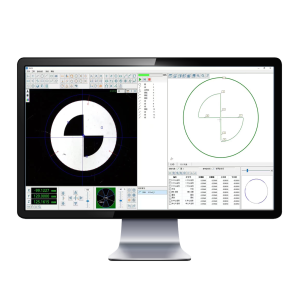
The proprietary measurement software utilises a modular architecture and is compatible with mainstream 3D CAD file formats such as DXF, IGES and STEP. It allows drawings to be imported directly to automatically generate measurement programmes, completing the entire process—including dimensional measurement, contour comparison, geometric tolerance calculation and defect detection—with a single click. The software consolidates all data collected from vision, laser and probe systems, automatically generating standardised inspection reports that record dimensional trends and defect statistics. This provides a comprehensive basis for data traceability to support process optimisation, eliminating the need to export and integrate data across multiple systems.

The system is suitable for mass-production quality inspection and laboratory R&D spot checks across a wide range of fields, including semiconductor chips, 3C connectors, new energy battery electrodes, precision medical components and micro-hardware fasteners. Batch workpieces can be tested immediately upon placement, with dozens of parameters outputted simultaneously within seconds. The system automatically classifies results as ‘OK’ or ‘NG’ and outputs sorting signals, catering to both high-precision R&D sampling and high-speed full inspection on production lines. It addresses the industry’s pain points—where traditional measuring equipment fails to balance accuracy, efficiency and versatility—and helps manufacturing enterprises establish an integrated, intelligent quality control system.
Product recommendation
TECHNICAL SOLUTION
MORE+You may also be interested in the following information
FREE CONSULTING SERVICE
Let’s help you to find the right solution for your project!
 ASK POMEAS
  PRICE INQUIRY
  REQUEST DEMO/TEST
  FREE TRIAL UNIT
  ACCURATE SELECTION
- APPICATION CASE
- RESOURCE CENTER
- DOWNLOAD CENTER
SOLUTIONS SUPPORT
- ZOOM LENS SELECTION TOOL
- TELECENTRIC LENS SELECTION TOOL
- FA LENS SELECTION TOOL
- ZOOM RATIO TABLE
- CERTIFIED MODEL
SELECTION TOOL
- WHY POMEAS
- FAQ
- PRIVACY POLICY
- TERMS OF USE
- DELIVERY & RETURN POLICY
CUSTOMER CARE
 ADDRESS
Add.:No.68, Yongwei Road, Baizhoubian, Dongcheng District, Dongguan, China,523000
CONTACT
 Tel:+ 86-0769-2266 0867
 Fax:+ 86-0769-2266 0867
 E-mail:marketing@pomeas.com

Wechat QR code

Software Copyright :2021SR0176001 抄袭必究, 技术支持:誉新源科技