


Telephoto lenses are a specialized type of optical lens widely used in machine vision, industrial inspection, and precision measurement. They eliminate perspective distortion, ensuring that the image edges and center maintain the same magnification, thereby improving inspection accuracy. Choosing a reliable manufacturer is crucial—it directly impacts equipment performance, inspection efficiency, and cost control.

I. Technical Specifications: Tailored to Actual Needs
-
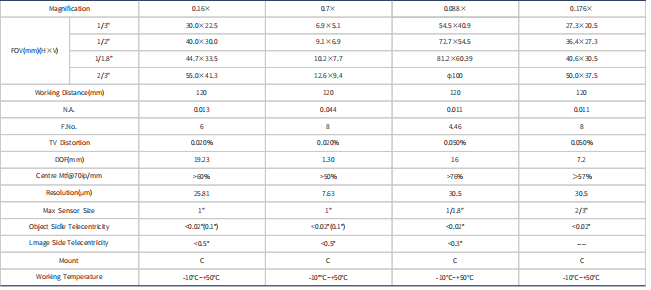
Magnification and Resolution: Select an appropriate magnification (e.g., 0.1× to 2×) based on the size of the inspection object (such as microelectronic components or large workpieces). The resolution must meet the minimum defect detection requirements to avoid misjudgments caused by insufficient pixels.
-
Depth of Field and Working Distance: Depth of field determines the range of depth that can be clearly imaged, while working distance affects installation flexibility. For example, high-speed production lines require lenses with short working distances, whereas complex environments require designs with a large depth of field.
-
Distortion Control: High-quality telecentric lenses should have a distortion rate below 0.1%. High distortion distorts the image and affects measurement accuracy; this can be verified using the MTF curves provided by the manufacturer.
II. Quality and Reliability: A Guarantee of Long-Term Stability
-
Materials and Coatings: Lenses should be made of materials with a low coefficient of thermal expansion (such as specialty glass) and feature multi-layer anti-reflective coatings to reduce stray light and reflections, ensuring suitability for high- and low-temperature or humid environments.
-
Quality Control Process: Give priority to manufacturers that provide comprehensive test reports covering the entire process, including shock resistance, dust resistance, and temperature drift tests. For example, in industrial settings, lenses must be able to withstand vibration and impact.
-
Compatibility: Ensure that the lens seamlessly matches the camera mount (such as C-mount or F-mount) and the lighting system to avoid additional adaptation costs.
III. Service Support: After-Sales Service and Customization Capabilities
-
Technical Support: Manufacturers should provide rapid troubleshooting and remote guidance, ideally with a response time of within 24 hours, to minimize production line downtime losses.
-
Warranty and Upgrades: A standard warranty period of at least 2 years is recommended, along with support for firmware or optical design upgrades to accommodate technological advancements.
-
Customization Options: For special requirements (such as non-standard dimensions or spectral ranges), manufacturers must have flexible design capabilities to shorten the development cycle.
Product recommendation
TECHNICAL SOLUTION
MORE+You may also be interested in the following information
FREE CONSULTING SERVICE
Let’s help you to find the right solution for your project!
 ASK POMEAS
  PRICE INQUIRY
  REQUEST DEMO/TEST
  FREE TRIAL UNIT
  ACCURATE SELECTION
- APPICATION CASE
- RESOURCE CENTER
- DOWNLOAD CENTER
SOLUTIONS SUPPORT
- ZOOM LENS SELECTION TOOL
- TELECENTRIC LENS SELECTION TOOL
- FA LENS SELECTION TOOL
- ZOOM RATIO TABLE
- CERTIFIED MODEL
SELECTION TOOL
- WHY POMEAS
- FAQ
- PRIVACY POLICY
- TERMS OF USE
- DELIVERY & RETURN POLICY
CUSTOMER CARE
 ADDRESS
Add.:No.68, Yongwei Road, Baizhoubian, Dongcheng District, Dongguan, China,523000
CONTACT
 Tel:+ 86-0769-2266 0867
 Fax:+ 86-0769-2266 0867
 E-mail:marketing@pomeas.com

Wechat QR code

Software Copyright :2021SR0176001 抄袭必究, 技术支持:誉新源科技