


How does the spectral system work in conjunction with the optical system to achieve autofocus?
The spectral system identifies the position of the sample or the focal point by analysing the spectral information captured by the optical system, thereby driving the microscope to focus automatically and ensuring clear and precise imaging.

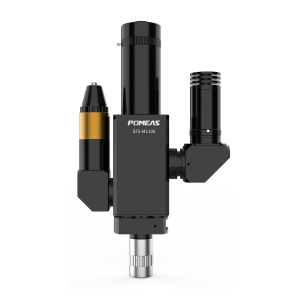
The Pain Points of Traditional Focusing
Conventional microscopes and industrial cameras rely on image contrast to determine the focal plane—scanning back and forth to find the ‘sharpest’ position, a process commonly known as the ‘hill-climbing method’. However, when dealing with transparent samples, low-reflectivity surfaces or high-speed moving scenes, the contrast signal becomes ‘blind’, resulting in a process that is not only slow but also prone to errors.
Principles of Spectroscopic Systems

The role played by the spectroscopic system here is that of a non-contact ‘optical calliper’. It emits a broad-spectrum beam of white light or near-infrared light coaxially onto the sample via an optical fibre or a beam-splitting optical path. After being reflected off the sample surface, this beam returns carrying ‘altitude information’.
The core mechanism lies in dispersive confocal imaging: in a dispersive confocal design, the lens assembly produces different focal points for light of different wavelengths, forming an axial ‘rainbow focal column’. Only the wavelength that falls precisely on the sample surface is reflected and efficiently passes through the confocal aperture into the detector.
Closed-loop Coordination: From ‘Distance Measurement’ to ‘Focus Lock’
The optical system (objective lens + tube lens + camera) is responsible for wide-field imaging. The spectral system, meanwhile, outputs a high-frequency distance reading in real time (thousands to tens of thousands of times per second). When the sample becomes out of focus due to thermal expansion, stage movement or surface tilt, the distance value drifts. The controller converts this drift into drive signals for piezoelectric ceramics or stepper motors, causing the objective or sample stage to move in the opposite direction to compensate for the deviation. The entire process is independent of image quality; even if the field of view is completely black or entirely transparent, the focus remains rock-solid.
The ingenuity of this collaboration lies in the fact that the spectroscopic system is concerned solely with the scalar quantity of ‘distance’, whilst the optical system is concerned solely with ‘taking photographs’. The two systems are synchronised via a clock; the spectroscopic system performs a ‘distance measurement and correction’ operation during the interval between each exposure frame, ensuring that the sample is precisely within ±50 nanometres of the focal plane for every camera exposure.
Product recommendation
TECHNICAL SOLUTION
MORE+You may also be interested in the following information
FREE CONSULTING SERVICE
Let’s help you to find the right solution for your project!
 ASK POMEAS
  PRICE INQUIRY
  REQUEST DEMO/TEST
  FREE TRIAL UNIT
  ACCURATE SELECTION
- APPICATION CASE
- RESOURCE CENTER
- DOWNLOAD CENTER
SOLUTIONS SUPPORT
- ZOOM LENS SELECTION TOOL
- TELECENTRIC LENS SELECTION TOOL
- FA LENS SELECTION TOOL
- ZOOM RATIO TABLE
- CERTIFIED MODEL
SELECTION TOOL
- WHY POMEAS
- FAQ
- PRIVACY POLICY
- TERMS OF USE
- DELIVERY & RETURN POLICY
CUSTOMER CARE
 ADDRESS
Add.:No.68, Yongwei Road, Baizhoubian, Dongcheng District, Dongguan, China,523000
CONTACT
 Tel:+ 86-0769-2266 0867
 Fax:+ 86-0769-2266 0867
 E-mail:marketing@pomeas.com

Wechat QR code

Software Copyright :2021SR0176001 抄袭必究, 技术支持:誉新源科技