



Dual-Spectral Opposite-Beam Measurement Solution | Film Thickness Measurement Case Study
In the production of transparent films, thickness uniformity is a key quality metric. Traditional contact-based thickness measurement can easily scratch the film surface, while conventional single-spectral detection is susceptible to fluctuations in transmittance and surface wrinkles, resulting in unstable measurement data that fails to meet the continuous monitoring requirements of high-speed production lines. The dual-spectral through-beam measurement solution uses two sets of light sources in different wavelength bands to capture signals. Through a multispectral data fusion algorithm, it compensates for interference caused by variations in material transmittance, enabling non-contact, high-precision in-line thickness measurement.

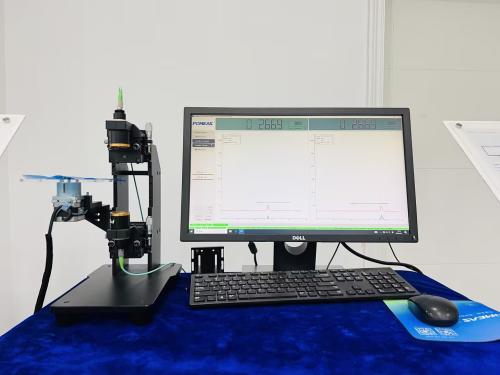
The film passes at a constant speed through two sets of opposing optical assemblies. Light in two specific wavelength bands passes through the film being measured, and the receiving end simultaneously captures the light intensity signals. The system compares the difference in light attenuation between the two spectra, filters out noise caused by dust or minor wrinkles on the film’s surface, and calculates the film’s thickness in real time. The entire solution requires no contact with the workpiece, features a fast response time, can keep pace with high-speed material flow on production lines, outputs thickness curves in real time, and automatically triggers an alarm signal when thickness deviates from specifications.

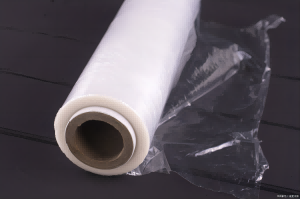
At this film inspection site, there were variations in light transmittance between batches of film, and changes in ambient light within the workshop also interfered with measurements. By utilizing dual-spectral differential calculations, the system effectively suppresses drift issues associated with single-spectral measurements and consistently maintains stable measurement accuracy. The system can continuously record thickness data and generate trend curves, providing quantitative data to support adjustments to the extrusion process and helping to reduce material waste caused by uneven thickness.
Compared to single-spectral transmittance measurement, the dual-spectral through-beam solution offers greater resistance to interference and is well-suited for products with significant fluctuations in light transmittance characteristics. The equipment is easy to install and can be directly integrated into existing production lines with a short retrofit cycle. It enables continuous monitoring across the full web width, replacing manual spot sampling and reducing the probability of missed defects.
For online thickness measurement of transparent, flexible materials, dual-spectral through-beam measurement has become a reliable solution for quality control in the film industry due to its excellent adaptability to various environmental conditions.
Product recommendation
TECHNICAL SOLUTION
MORE+You may also be interested in the following information
FREE CONSULTING SERVICE
Let’s help you to find the right solution for your project!

 ASK POMEAS
  PRICE INQUIRY
  REQUEST DEMO/TEST
  FREE TRIAL UNIT
  ACCURATE SELECTION
- APPICATION CASE
- RESOURCE CENTER
- DOWNLOAD CENTER
SOLUTIONS SUPPORT
- ZOOM LENS SELECTION TOOL
- TELECENTRIC LENS SELECTION TOOL
- FA LENS SELECTION TOOL
- ZOOM RATIO TABLE
- CERTIFIED MODEL
SELECTION TOOL
- WHY POMEAS
- FAQ
- PRIVACY POLICY
- TERMS OF USE
- DELIVERY & RETURN POLICY
CUSTOMER CARE
 ADDRESS
Add.:No.68, Yongwei Road, Baizhoubian, Dongcheng District, Dongguan, China,523000
CONTACT
 Tel:+ 86-0769-2266 0867
 Fax:+ 86-0769-2266 0867
 E-mail:marketing@pomeas.com

Wechat QR code

Software Copyright :2021SR0176001 抄袭必究, 技术支持:誉新源科技