


In the field of electronics manufacturing, FPGAs (Field-Programmable Gate Arrays) are highly integrated circuit components, and the quality of their solder joints directly affects product performance and reliability. Among these factors, the precise measurement of solder joint height is one of the key indicators for evaluating soldering quality.

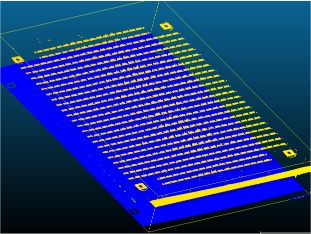
Testing Protocol

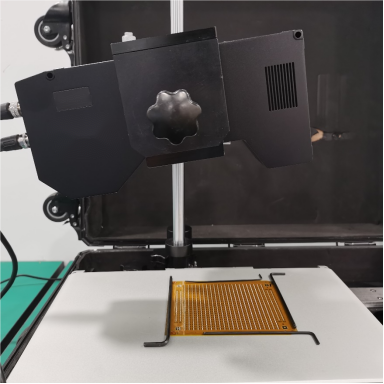
The solution employs a line laser profile scanning sensor to capture 3D profile data of FPGA solder joints using a non-contact measurement method. To minimize the impact of environmental noise on measurement results, the camera must be tilted approximately 10° during sensor installation. This design ingeniously leverages optical principles to effectively filter out some interference signals, thereby improving measurement accuracy.
Testing Process

1. Data Acquisition: A line laser profilometer rapidly scans the surface of the FPGA to generate high-precision 3D point cloud data.
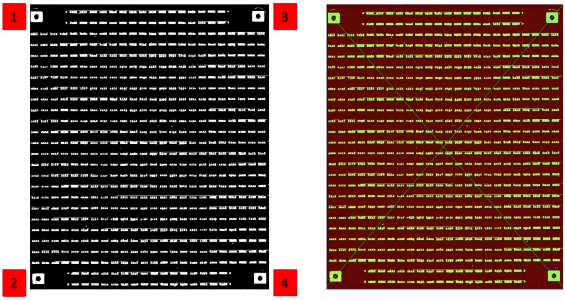
2. Image Processing: Using specialized inspection software, the 3D point cloud data is converted into grayscale images for subsequent analysis and processing. By identifying the intersection coordinates of the lines connecting the centers of the circles in regions 1 and 4 with those in regions 2 and 3, the product is precisely positioned, ensuring a consistent reference plane for each measurement.
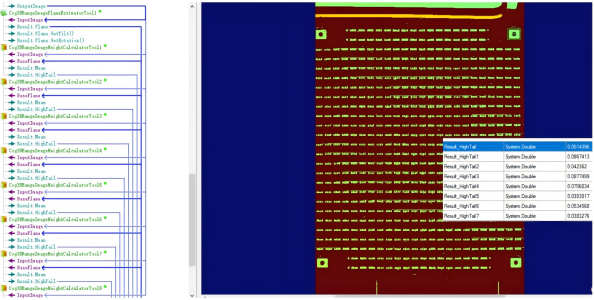
3. Height Calculation: In the 3D model of the positioned product, key points are selected from four square regions (1, 2, 3, and 4) to fit a reference plane. Subsequently, by calculating the height difference of each solder joint relative to this reference plane, precise height data for the solder joints is obtained.
Results

Advantages of the Solution
- High Precision: Non-contact measurement eliminates errors caused by physical contact, and the tilted camera design further enhances measurement accuracy.
- High Efficiency: Automated processes significantly reduce inspection time and improve production efficiency.
- High Stability: Through precise positioning and reference plane fitting, errors caused by uneven product placement are effectively compensated for, ensuring the stability and reliability of the data.
Addressing Testing Challenges
To meet the requirement that products remain flat during measurement, this solution optimizes the design of the measurement platform and employs high-precision positioning fixtures to ensure the stability of the FPGA throughout the measurement process. Additionally, the software’s automatic calibration feature compensates to some extent for minor surface irregularities in the product, further enhancing measurement accuracy.
Validation Testing

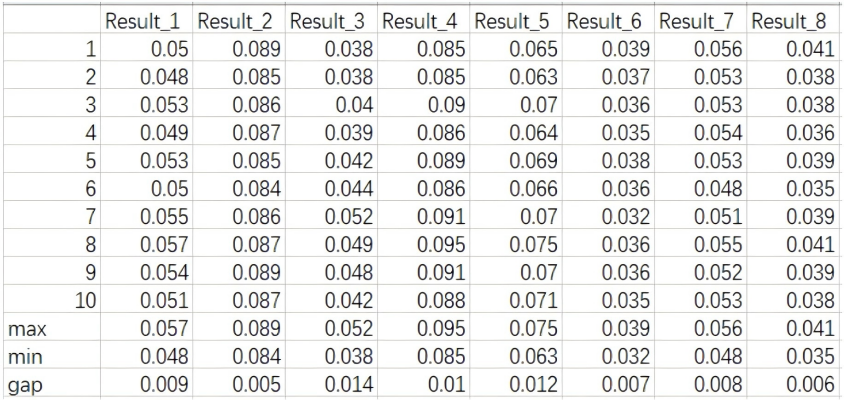
To verify the reliability of the solution, multiple solder joints on the FPGA were selected for 10 round-trip tests. The results showed minimal fluctuation in the height data for each solder joint, demonstrating the solution’s exceptional performance in terms of data stability.
Product recommendation
TECHNICAL SOLUTION
MORE+You may also be interested in the following information
FREE CONSULTING SERVICE
Let’s help you to find the right solution for your project!

 ASK POMEAS
  PRICE INQUIRY
  REQUEST DEMO/TEST
  FREE TRIAL UNIT
  ACCURATE SELECTION
- APPICATION CASE
- RESOURCE CENTER
- DOWNLOAD CENTER
SOLUTIONS SUPPORT
- ZOOM LENS SELECTION TOOL
- TELECENTRIC LENS SELECTION TOOL
- FA LENS SELECTION TOOL
- ZOOM RATIO TABLE
- CERTIFIED MODEL
SELECTION TOOL
- WHY POMEAS
- FAQ
- PRIVACY POLICY
- TERMS OF USE
- DELIVERY & RETURN POLICY
CUSTOMER CARE
 ADDRESS
Add.:No.68, Chongwei Road, Baizhoubian, East district, Dongguan, China, 523000
CONTACT
 Tel:+ 86-0769-2266 0867
 Fax:+ 86-0769-2266 0867
 E-mail:marketing@pomeas.com

Wechat QR code

Software Copyright :2021SR0176001 抄袭必究, 技术支持:誉新源科技