


Testing Background

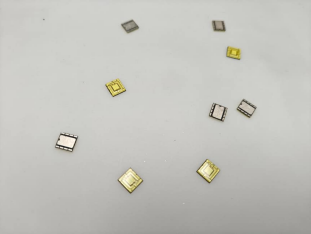
Southern China is the country’s core industrial cluster for ceramic UV-LED packaging. UVA (365/385/405 nm) LED chips, as the primary light source for industrial curing, are widely used in sectors such as printing, electronics manufacturing, and optical bonding, and are produced on a large scale. After production, the finished LED chips are stacked and discharged, and must be quickly sorted and loaded onto trays according to specifications and appearance; traditionally, this sorting process has relied on manual labor.
Challenges in Testing
LED chips measuring 10 × 10 mm or smaller are classified as small, irregularly shaped components; when sorted manually by visual inspection, they are difficult to distinguish when stacked. In high-volume production, manual inspection creates a significant bottleneck in efficiency, resulting in high rates of missed and false inspections. Additionally, due to the repetitive nature of the work, employee turnover is high, making recruitment difficult and management costs expensive.
Solutions

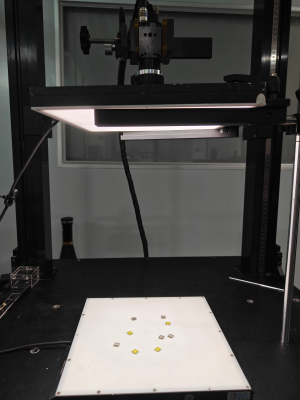
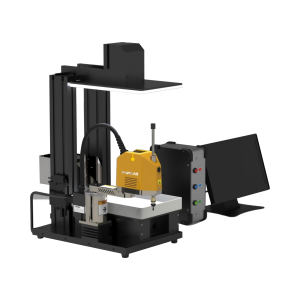
A solution combining vision-based positioning and automated sorting using a robotic arm is employed.

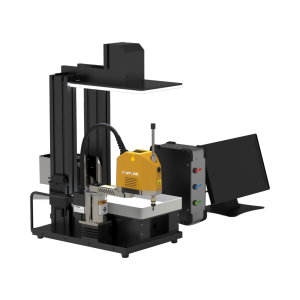
1. The entire system is centered around a high-performance all-in-one vision and motion control unit, equipped with a Gigabit Ethernet industrial area-scan camera, a high-definition lens, and a diffuse light source. The camera is mounted directly above the sorting station, with a field of view covering the entire vibrating feeder’s operating area;
2. A high-speed, flexible vibratory feeder is used to level the material. Through a high-precision hand-eye calibration algorithm, image coordinates are converted into spatial motion coordinates for the robotic arm, guiding the parallel-arm robotic system to perform graded picking and sorted placement according to predefined rules.
Advantages of the Solution
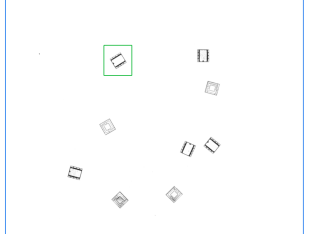

1. A single calibration ensures long-term stable operation, unaffected by obstructions caused by the robotic arm’s movements; it can automatically plan the optimal grasping path for stacking workpieces, requiring no manual intervention throughout the process;
2. Dozens of material process packages can be pre-stored; product changeovers require only a single-button call, with debugging completed in just a few minutes, making it ideal for flexible production of multiple varieties in small batches;
3. A single unit requires only one person for periodic material replenishment and supports 24/7 continuous operation, significantly reducing labor costs.
TECHNICAL SOLUTION
MORE+You may also be interested in the following information
EASY ROBOT FEEDER

FREE CONSULTING SERVICE
Let’s help you to find the right solution for your project!
 ASK POMEAS
  PRICE INQUIRY
  REQUEST DEMO/TEST
  FREE TRIAL UNIT
  ACCURATE SELECTION
- APPICATION CASE
- RESOURCE CENTER
- DOWNLOAD CENTER
SOLUTIONS SUPPORT
- ZOOM LENS SELECTION TOOL
- TELECENTRIC LENS SELECTION TOOL
- FA LENS SELECTION TOOL
- ZOOM RATIO TABLE
- CERTIFIED MODEL
SELECTION TOOL
- WHY POMEAS
- FAQ
- PRIVACY POLICY
- TERMS OF USE
- DELIVERY & RETURN POLICY
CUSTOMER CARE
 ADDRESS
Add.:No.68, Yongwei Road, Baizhoubian, Dongcheng District, Dongguan, China,523000
CONTACT
 Tel:+ 86-0769-2266 0867
 Fax:+ 86-0769-2266 0867
 E-mail:marketing@pomeas.com

Wechat QR code

Software Copyright :2021SR0176001 抄袭必究, 技术支持:誉新源科技