


How should industrial cameras and industrial lenses be used together?
The proper pairing of industrial cameras and lenses is at the heart of machine vision systems, directly affecting image quality and inspection accuracy. Lenses handle optical imaging, while cameras handle photoelectric conversion and processing; the two must be matched in terms of parameters to ensure efficient collaboration.

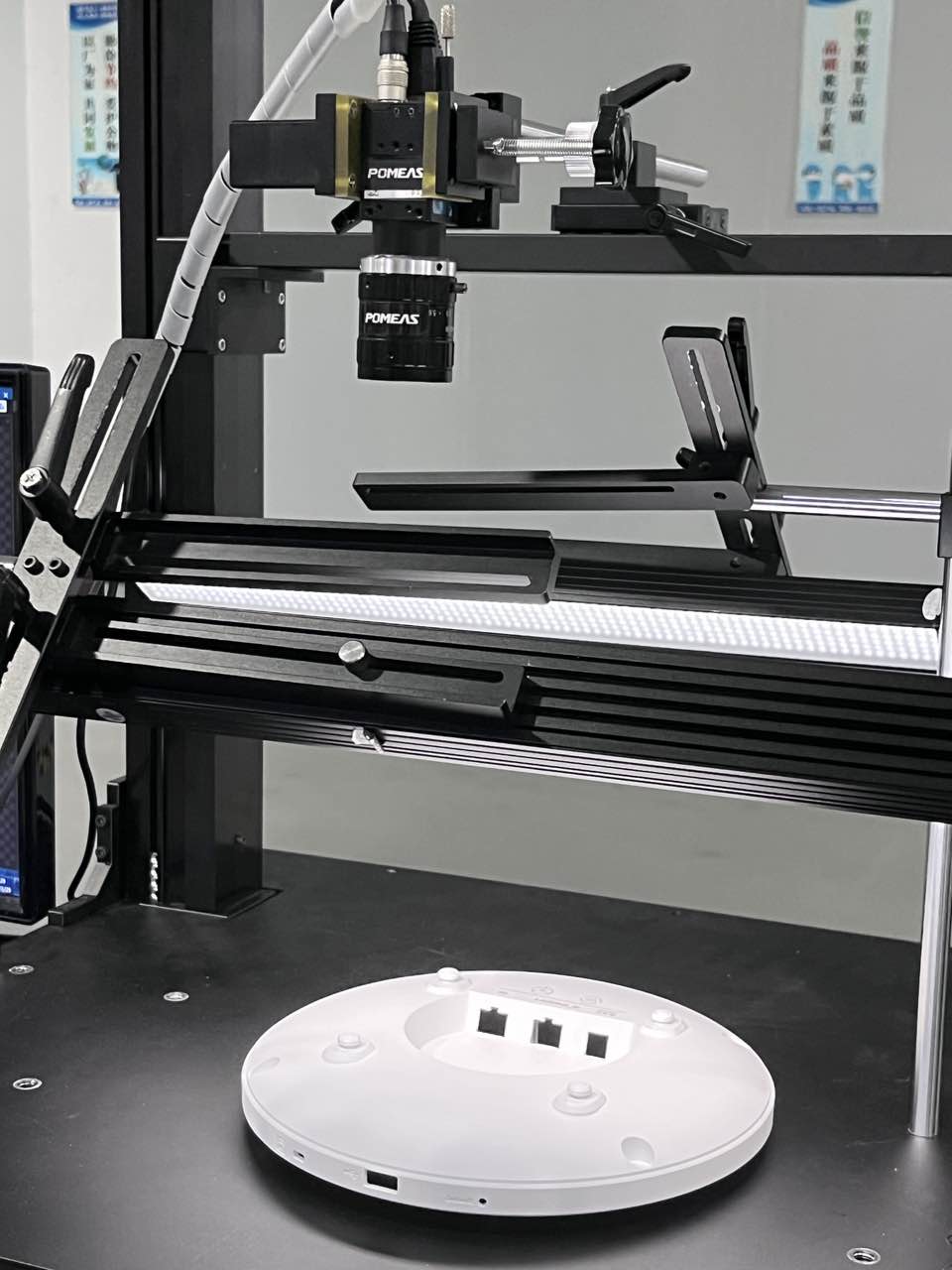
I. Core Pairing Principles
1. Sensor and Image Circle Matching: The lens’s imaging area (image circle) must cover the size of the camera sensor. For example, a 1/1.8-inch sensor (diagonal length approximately 9 mm) requires a lens with an image circle of ≥9 mm; otherwise, vignetting or blurred edges may occur. A full-frame sensor (36 mm × 24 mm) requires a dedicated full-frame lens.
2. Resolution Coordination: The lens resolution (line pairs per millimeter, LP/mm) must exceed the camera sensor’s resolution. For example, a 20-megapixel camera requires a lens with ≥100 LP/mm; otherwise, the lens will become a bottleneck in image formation, resulting in blurry images.
3. Calculating Focal Length and Working Distance: Determine the field of view (FOV) and working distance (WD) based on inspection requirements, then calculate the required focal length using the formula: Focal Length = (Sensor Size × Working Distance) / Field of View.
4. Balancing Aperture and Depth of Field: A small aperture (high f-number) increases depth of field, making it suitable for 3D object inspection; A large aperture (low f-number) increases light intake but reduces depth of field. Select an appropriate aperture based on the flatness of the inspection object.
5. Standardize Interface Types: Common interfaces include the C-mount (17.5 mm flange distance), CS-mount (12.5 mm flange distance), and F-mount. C-mount and CS-mount lenses require an adapter ring for proper alignment; otherwise, they will not focus correctly.
II. Scenario-Based Styling Solutions
1. Advantages for high-speed production line inspection: high frame rate (≥100 fps), wide field of view, and fast response. Example solution: low-distortion, large-aperture fixed-focus lens (e.g., f/1.4) + global shutter CMOS camera to prevent motion blur.
2. Advantages for detecting minute defects (e.g., on semiconductor chips): High resolution, large depth of field, low distortion. Example solution: A combination of a telecentric lens (to eliminate perspective distortion) and a macro lens, paired with a high-resolution (≥50 million pixels) CCD camera.
3. 3D measurement and modeling: Enables multi-view synchronization, high precision, and low error. Example solution: Dual telecentric lenses + multiple high-frame-rate cameras, combined with a structured light or laser projector.
Product recommendation
TECHNICAL SOLUTION
MORE+You may also be interested in the following information
FREE CONSULTING SERVICE
Let’s help you to find the right solution for your project!
 ASK POMEAS
  PRICE INQUIRY
  REQUEST DEMO/TEST
  FREE TRIAL UNIT
  ACCURATE SELECTION
- APPICATION CASE
- RESOURCE CENTER
- DOWNLOAD CENTER
SOLUTIONS SUPPORT
- ZOOM LENS SELECTION TOOL
- TELECENTRIC LENS SELECTION TOOL
- FA LENS SELECTION TOOL
- ZOOM RATIO TABLE
- CERTIFIED MODEL
SELECTION TOOL
- WHY POMEAS
- FAQ
- PRIVACY POLICY
- TERMS OF USE
- DELIVERY & RETURN POLICY
CUSTOMER CARE
 ADDRESS
Add.:No.68, Yongwei Road, Baizhoubian, Dongcheng District, Dongguan, China,523000
CONTACT
 Tel:+ 86-0769-2266 0867
 Fax:+ 86-0769-2266 0867
 E-mail:marketing@pomeas.com

Wechat QR code

Software Copyright :2021SR0176001 抄袭必究, 技术支持:誉新源科技