


ZOOM LENS—Precision Positioning Inspection of Transparent Fiber Optic Heads
Testing Background
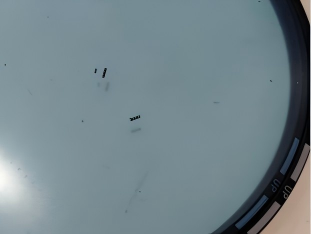
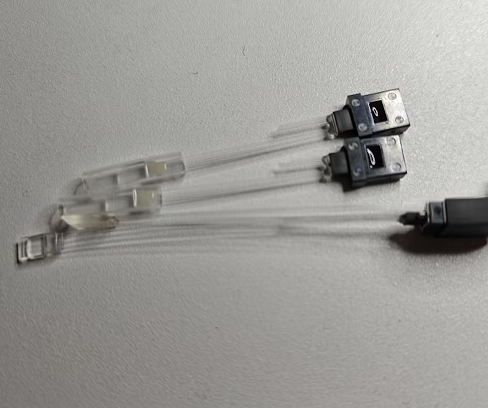
An optoelectronics company specializes in the R&D and production of fiber optic communication modules. One of its core processes involves high-precision geometric feature capture of transparent fiber optic connectors. This process requires automated equipment to quickly locate the center of the fiber optic profile, extract the centerlines of the upper and lower edges, and measure the distance from the rightmost edge to the center point to determine whether the product meets assembly tolerances. The existing vision system suffered from insufficient lens resolution, resulting in blurry images and a persistently high failure rate in feature extraction, which severely impacted the efficiency of 100% inspection.
Challenges in Testing
- The object under test is a fiber optic connector with high light transmittance; standard lenses tend to lose edge contrast and produce blurred contours during imaging;
- The fiber end face features microscopic curvature and reflections; stray light and low resolution make it difficult to clearly define the upper and lower edge lines;
- The measurement accuracy from the right edge to the center must be at the micrometer level; blurred images cannot provide the algorithm with a stable edge transition zone.
Testing Requirements
-
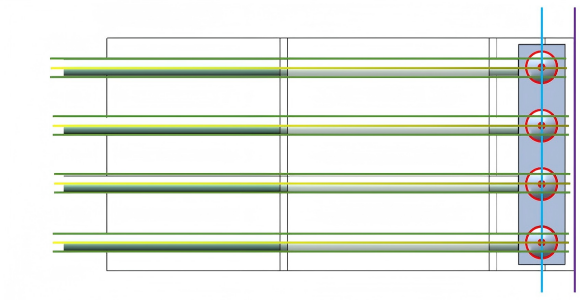
Accurately capture the center of the product contour; the repeatability of the center point must be less than 0.005 mm;
-
Select the upper and lower new boundaries of the fiber optic cable and determine the exact centerline through fitting;
-
Capture the rightmost edge of the product and calculate its Euclidean distance from the center of the contour;
-
Compare the resulting distance value with the product’s design tolerance range to automatically determine whether it passes (OK) or fails (NG).
Solutions
After multiple rounds of optical testing, the POMEAS 68 series of high-resolution ZOOM LENSES was ultimately selected, paired with a combination of white flat-panel backlighting and white ring lighting.
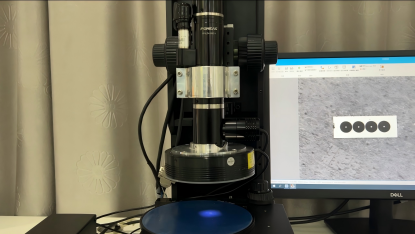
1. A flat light source is projected from below the fiber optic cable to capture sharp outer contours; a ring light supplements the front lighting at a low angle to eliminate dark areas inside the transparent object.
2. The ZOOM LENS is adjusted to the appropriate magnification range to balance the field of view and detail resolution.
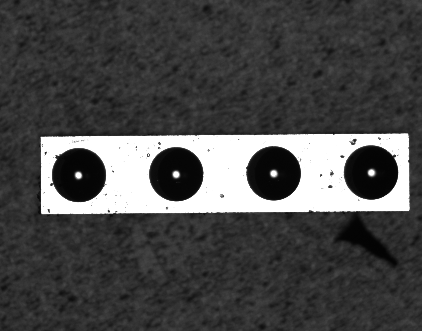
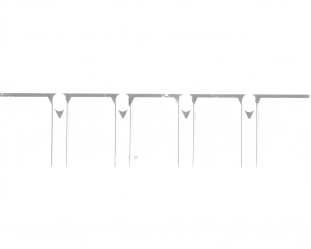
3. After the camera captures the image, the vision algorithm easily locates edge points on the high-contrast image and reliably identifies the center, centerline, and right margin.
Advantages of the Solution
1. The POMEAS 68 series lenses offer excellent resolution and chromatic aberration correction, providing high contrast at the edges of transparent objects;
2. The ZOOM LENS design is compatible with fiber optic heads of various specifications; simply adjust the magnification to quickly switch between models;
3. The multi-light source solution addresses the common challenge of insufficient contrast in the inspection of transparent materials, clearly displaying both contours and internal features simultaneously;
4. The lenses offer excellent focus consistency; no refocusing is required after zooming, significantly improving the inspection cycle time in online inspection.
Test Results
Product recommendation
TECHNICAL SOLUTION
MORE+You may also be interested in the following information
FREE CONSULTING SERVICE
Let’s help you to find the right solution for your project!
 ASK POMEAS
  PRICE INQUIRY
  REQUEST DEMO/TEST
  FREE TRIAL UNIT
  ACCURATE SELECTION
- APPICATION CASE
- RESOURCE CENTER
- DOWNLOAD CENTER
SOLUTIONS SUPPORT
- ZOOM LENS SELECTION TOOL
- TELECENTRIC LENS SELECTION TOOL
- FA LENS SELECTION TOOL
- ZOOM RATIO TABLE
- CERTIFIED MODEL
SELECTION TOOL
- WHY POMEAS
- FAQ
- PRIVACY POLICY
- TERMS OF USE
- DELIVERY & RETURN POLICY
CUSTOMER CARE
 ADDRESS
Add.:No.68, Yongwei Road, Baizhoubian, Dongcheng District, Dongguan, China,523000
CONTACT
 Tel:+ 86-0769-2266 0867
 Fax:+ 86-0769-2266 0867
 E-mail:marketing@pomeas.com

Wechat QR code

Software Copyright :2021SR0176001 抄袭必究, 技术支持:誉新源科技