


In applications such as electronic assembly, precision mould maintenance and materials research, operators are often faced with a dilemma: at low magnification, the field of view is sufficiently large to facilitate rapid positioning, but fine details are unclear; at high magnification, minute features can be distinguished, but the depth of field is extremely shallow, meaning that even the slightest variation in the workpiece’s surface requires refocusing. If the sample itself has variations in height, or if multiple features in different locations need to be observed simultaneously, manual refocusing becomes an exceptionally frequent task, severely disrupting the inspection workflow.

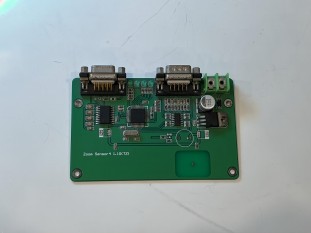
The motorised zoom autofocus microscope integrates ‘motorised continuous zoom’ and ‘real-time autofocus’ technologies, ensuring that the operator always obtains a clear image regardless of how they change the magnification or move the specimen, thereby delivering a truly seamless observation experience where the image follows the operator’s gaze.
I. Motorised Zoom: Magnification switching requires no manual intervention

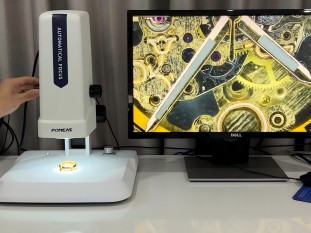
Traditional continuous zoom microscopes rely on a manually rotated zoom ring; the feel of this varies from person to person, and the magnification value can only be roughly estimated from the scale markings. Motorised zoom solutions utilise a motor-driven optical zoom system, allowing magnification adjustment via a controller, foot switch or software commands. The standard optical zoom range typically extends from 0.7× to 5.6× (which can be extended to higher magnifications with auxiliary objectives), whilst electronic magnification can reach over 200×.
The magnification switching process is smooth and seamless, and supports preset magnifications and one-touch recall—operators can store frequently used magnifications (such as low magnification for positioning, medium magnification for inspection, and high magnification for verification) separately, and switch directly when required, without having to repeatedly search for the appropriate magnification. For production lines requiring the repeated inspection of large numbers of similar workpieces, this effectively reduces the time taken per inspection and minimises operator fatigue.
II. Real-time Autofocus: The image remains clear at all times, even when moving the specimen or changing the magnification
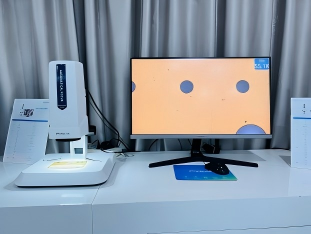
The key advantage of an electric zoom autofocus microscope lies in its closed-loop autofocus system. The system incorporates a built-in distance sensor or an algorithm based on image sharpness evaluation to monitor changes in the focal plane in real time. When the operator moves the specimen stage or changes the magnification, the system drives the focus motor to automatically compensate within milliseconds, ensuring that the target remains in focus at all times.
This feature is particularly useful in the following two typical scenarios:
-
Samples with varying heights: For example, when PCBs contain a mix of tall and short components, traditional microscopes require frequent adjustment of the focus ring; in autofocus mode, the operator simply needs to move the sample, and the focus will automatically follow the changes in surface height.
-
Magnification switching:When switching from low to high magnification, the image usually becomes blurred due to changes in optical properties; the autofocus system is able to immediately re-lock the focus, eliminating the need for manual fine-tuning.
III. Adaptability to Complex Optical Paths and Various Lighting Methods

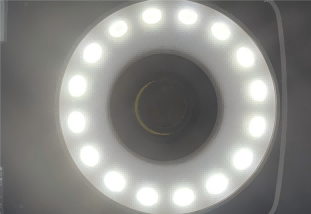
The stability of autofocus relies heavily on image contrast. This type of microscope is typically equipped with a programmable LED ring light or coaxial epi-illumination, allowing users to select different angles and intensities of illumination depending on the sample material (metal, plastic, glass, ceramic), thereby eliminating localised reflections or shadows and providing high-quality image input for the autofocus algorithm. Furthermore, the light source parameters can be automatically adjusted in response to changes in magnification (for example, activating the ring light for uniform illumination at low magnifications and enhancing the coaxial illumination to highlight fine textures at high magnifications), thereby further improving the observation results.
Key Insights into Application Scenarios:
Motorised zoom autofocus microscopes are particularly well-suited to applications requiring frequent adjustments to magnification or specimen height, such as PCBA repair workshops, the assembly and adjustment of precision moulds, metallographic analysis of materials, and the observation of living organisms.
Product recommendation
TECHNICAL SOLUTION
MORE+You may also be interested in the following information
FREE CONSULTING SERVICE
Let’s help you to find the right solution for your project!
 ASK POMEAS
  PRICE INQUIRY
  REQUEST DEMO/TEST
  FREE TRIAL UNIT
  ACCURATE SELECTION
- APPICATION CASE
- RESOURCE CENTER
- DOWNLOAD CENTER
SOLUTIONS SUPPORT
- ZOOM LENS SELECTION TOOL
- TELECENTRIC LENS SELECTION TOOL
- FA LENS SELECTION TOOL
- ZOOM RATIO TABLE
- CERTIFIED MODEL
SELECTION TOOL
- WHY POMEAS
- FAQ
- PRIVACY POLICY
- TERMS OF USE
- DELIVERY & RETURN POLICY
CUSTOMER CARE
 ADDRESS
Add.:No.68, Yongwei Road, Baizhoubian, Dongcheng District, Dongguan, China,523000
CONTACT
 Tel:+ 86-0769-2266 0867
 Fax:+ 86-0769-2266 0867
 E-mail:marketing@pomeas.com

Wechat QR code

Software Copyright :2021SR0176001 抄袭必究, 技术支持:誉新源科技