


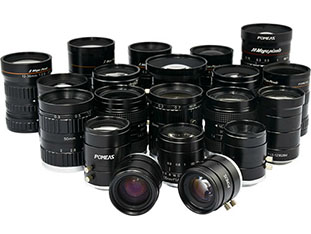
In the practical application of industrial camera lenses, AF (autofocus) and MF (manual focus) are not simply a matter of switching between functions, but rather two entirely different focusing logics. Put simply, AF prioritises speed and convenience, making it suitable for fast-paced shooting in ever-changing scenarios; MF, on the other hand, prioritises the utmost stability and repeatability, and is the standard choice for the vast majority of high-precision measurement, positioning and inspection applications. If your application requires micrometre-level precision and long-term stability, then MF is often the more reliable choice.

I. Definitions of AF and MF
AF:which stands for Auto Focus, refers to automatic focusing. The lens incorporates a built-in motor or drive mechanism; based on information such as image contrast and phase difference captured by the camera, an algorithm automatically determines the correct focus position and drives the lens elements to move until the image is in focus. The entire process requires no manual intervention.
MF:which stands for Manual Focus, requires the operator to directly alter the optical back focus or the position of the lens elements by rotating the lens’s focus ring or adjusting the focus mechanism. By visually monitoring the viewfinder, scale markings or auxiliary focusing tools, the operator precisely locks the focus onto the target plane.
II. Selection Criteria for Machine Vision Inspection Solutions
When designing a machine vision inspection solution, the choice between AF and MF directly determines the system’s long-term accuracy, deployment efficiency and resistance to interference. There is only one key criterion for this decision: whether the working distance between the object under inspection and the lens remains constant during mass production.
III. Practical Guidelines for Selecting Solutions
-
If the object under test is secured by a mechanical fixture, the distance remains constant, or micrometre-level precision is required, please lock the focus manually (MF) to minimise stability risks.
-
If the detection distance frequently varies and cannot be standardised, and the objects to be recognised are primarily barcodes, characters or larger contours, then an autofocus (AF) solution may be considered, provided that a stable and consistent trigger source and a tested and validated algorithm are available.
-
Never rely on AF to fully compensate for environmental interference through its own algorithms alone at workstations where vibration exceeds acceptable limits or where lighting fluctuates drastically; a structure utilising locked MF is far more reliable under such conditions.
Product recommendation
TECHNICAL SOLUTION
MORE+You may also be interested in the following information
FREE CONSULTING SERVICE
Let’s help you to find the right solution for your project!
 ASK POMEAS
  PRICE INQUIRY
  REQUEST DEMO/TEST
  FREE TRIAL UNIT
  ACCURATE SELECTION
- APPICATION CASE
- RESOURCE CENTER
- DOWNLOAD CENTER
SOLUTIONS SUPPORT
- ZOOM LENS SELECTION TOOL
- TELECENTRIC LENS SELECTION TOOL
- FA LENS SELECTION TOOL
- ZOOM RATIO TABLE
- CERTIFIED MODEL
SELECTION TOOL
- WHY POMEAS
- FAQ
- PRIVACY POLICY
- TERMS OF USE
- DELIVERY & RETURN POLICY
CUSTOMER CARE
 ADDRESS
Add.:No.68, Yongwei Road, Baizhoubian, Dongcheng District, Dongguan, China,523000
CONTACT
 Tel:+ 86-0769-2266 0867
 Fax:+ 86-0769-2266 0867
 E-mail:marketing@pomeas.com

Wechat QR code

Software Copyright :2021SR0176001 抄袭必究, 技术支持:誉新源科技