


The key reason why low-distortion telecentric lenses are suitable for precision measurement is that they simultaneously suppress imaging errors caused by both image distortion and variations in object distance, resulting in measurements that are closer to the actual values. Therefore, they offer significant advantages in precision dimensional calibration, appearance defect inspection, and the measurement of micro-components.
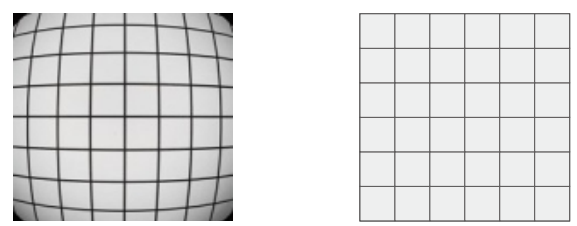
I. Limitations of Standard Lenses in Measurement
Standard industrial lenses follow the perspective principle of “near objects appear larger and far objects appear smaller.” When the height at which a workpiece is placed varies slightly, the working distance fluctuates due to vibration, or the thickness of parts from different batches is inconsistent, the same actual dimension will be represented by a different number of pixels in the image, causing measurement results to drift. In addition, standard lenses exhibit significant edge distortion; circular edges may appear elliptical, and straight lines may appear curved, requiring additional algorithmic correction—though the correction itself can also introduce errors.
II. How Does a Telecentric Design Stabilize the Magnification?
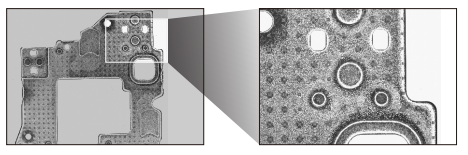
Telephoto lenses position the aperture diaphragm near the object-side focal plane, causing the main rays of light entering the lens to be essentially parallel to the optical axis. As a result, only rays that are approximately parallel to the optical axis form an image, and the size of the image remains virtually unchanged as the object moves forward or backward within the depth of field. For measurement systems, this means that even with slight fluctuations in the working distance, the pixel equivalent remains stable, resulting in higher repeatability in measurement accuracy.
III. Why Is Low Distortion So Important?
Distortion is caused by inconsistent magnification across different positions within the field of view. Low-distortion telecentric lenses typically keep distortion to a minimum, resulting in a more consistent aspect ratio between the center and edges of the image. After camera calibration, size conversions can be performed directly using a fixed pixel equivalent, eliminating the need for complex distortion models and reducing the propagation of calibration errors. In scenarios requiring the inspection of geometric parameters such as circularity, straightness, and spacing, low distortion ensures more reliable output from measurement algorithms.
IV. Value in Practical Applications
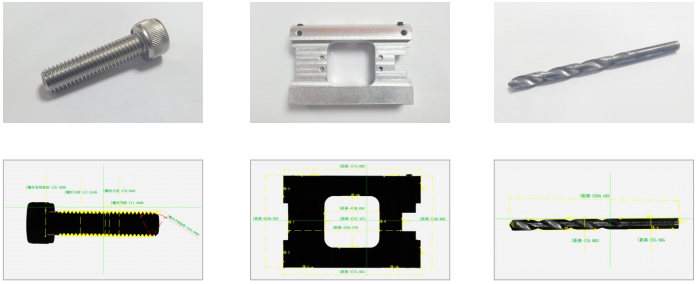
When inspecting micro-apertures, connector pin pitches, the contours of precision stamped parts, and the dimensions of precision injection-molded parts, low-distortion telecentric lenses provide high-contrast, low-distortion images, enabling edge detection with sub-pixel accuracy. Even if there are slight height differences or clamping position deviations in the parts, measurement results are not significantly affected by changes in object distance. This enhances the stability of in-line inspection and equipment compatibility.
It is important to note that when selecting a telecentric lens, the lens aperture must be larger than the field of view being measured, and it must be paired with appropriate parallel or coaxial illumination; otherwise, peripheral light will be blocked, affecting image quality. Additionally, the selection should be based on a comprehensive evaluation of the field of view, working distance, depth of field, and camera sensor size, rather than focusing solely on resolution parameters.
Product recommendation
TECHNICAL SOLUTION
MORE+You may also be interested in the following information
FREE CONSULTING SERVICE
Let’s help you to find the right solution for your project!
 ASK POMEAS
  PRICE INQUIRY
  REQUEST DEMO/TEST
  FREE TRIAL UNIT
  ACCURATE SELECTION
- APPICATION CASE
- RESOURCE CENTER
- DOWNLOAD CENTER
SOLUTIONS SUPPORT
- ZOOM LENS SELECTION TOOL
- TELECENTRIC LENS SELECTION TOOL
- FA LENS SELECTION TOOL
- ZOOM RATIO TABLE
- CERTIFIED MODEL
SELECTION TOOL
- WHY POMEAS
- FAQ
- PRIVACY POLICY
- TERMS OF USE
- DELIVERY & RETURN POLICY
CUSTOMER CARE
 ADDRESS
Add.:No.68, Yongwei Road, Baizhoubian, Dongcheng District, Dongguan, China,523000
CONTACT
 Tel:+ 86-0769-2266 0867
 Fax:+ 86-0769-2266 0867
 E-mail:marketing@pomeas.com

Wechat QR code

Software Copyright :2021SR0176001 抄袭必究, 技术支持:誉新源科技