


Telecentric lenses are specialized optical lenses designed for high-precision inspection applications in machine vision. Through their unique parallel optical path design, they eliminate perspective errors and depth-of-field distortion. As indispensable core optical components for measuring the dimensions of minute workpieces and detecting surface defects, they are widely used in quality inspection processes across various fields of precision manufacturing.

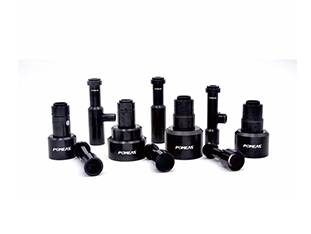
Q1:What is a telecentric lens?


Conventional industrial lenses produce a perspective effect where nearby objects appear larger and distant objects smaller. Even a slight deviation in the distance between the lens and the workpiece being measured can result in measurement errors. Telecentric lenses use a special internal optical structure to adjust incident light into parallel beams that strike the object perpendicularly. They are primarily classified into three types: object-side telecentric, image-side telecentric, and dual-telecentric.
Their most significant design feature is the placement of the aperture diaphragm at the lens’s focal plane, which constrains the angle of incidence of light. This design eliminates the perspective distortion inherent in ordinary lenses through optical principles, offering far greater precision in controlling the optical path than standard fixed-focus lenses. These lenses are specifically designed for vision systems that demand strict requirements for measurement repeatability and data stability.
Q2:What effects can a telecentric lens achieve?
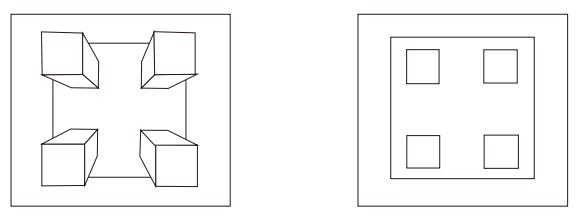
First, it completely eliminates perspective errors. Even if there are slight variations in the height of the workpiece or minor positioning deviations, the size of the imaged contour remains consistent, and fluctuations in repeated measurement data are minimal, significantly improving the repeatability of dimensional inspection.
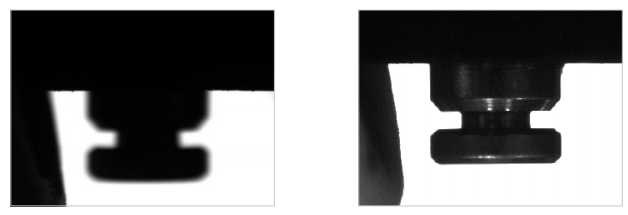
Second, the edge imaging is sharp and clear. The imaging of parallel light rays does not result in blurred edges or shadow interference, ensuring that even minute defects—such as tiny scratches, burrs, notches, and micro-pores—are fully captured, thereby reducing the likelihood of missed detections and misjudgments by visual algorithms.
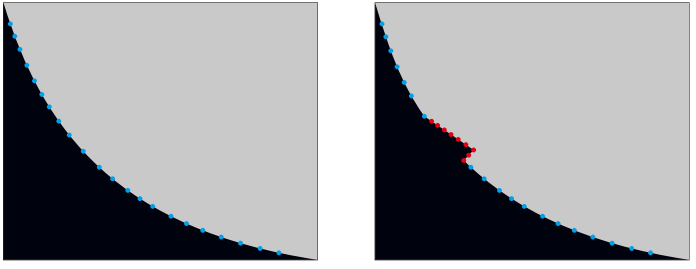
Third, it supports stable imaging with a large depth of field. Within the specified working distance range, even with slight forward or backward displacement of the workpiece, a complete and clear image can still be obtained, reducing the difficulty of debugging fixture positioning on automated production lines and improving the equipment’s operational fault tolerance.
According to industry-standard test data, a qualified double-telecentric lens can control repeatability measurement errors to the micrometer level, far exceeding the upper limit of detection accuracy for ordinary industrial lenses.
Q3:In which industries can telecentric lenses be used?

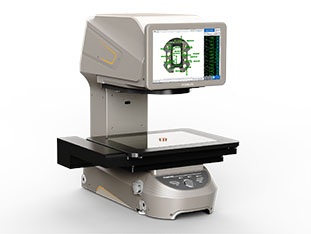
1. Semiconductor and Electronic Components Industry: Used for wafer appearance inspection, measurement of micro-surface-mount component lead dimensions, verification of chip encapsulation contours, and inspection of PCB trace widths and via diameters.
2. Precision Hardware and Fasteners Industry: Batch online measurement of the outer diameter, step height, and chamfer dimensions of micro-screws, springs, and small stamped parts.
3. Medical Device Industry: Non-destructive inspection of medical tubing wall thickness, needle inner diameters, and the geometries of precision plastic components.
4. Plastics and Glass Products Industry: Visual verification of the contours of transparent injection-molded parts, the flatness of glass cover plates, and the geometric parameters of lenses.
5. New Energy Industry: High-precision visual inspection of lithium-ion battery electrode edge defects, tab dimensions, and sealant paths.
Product recommendation
TECHNICAL SOLUTION
MORE+You may also be interested in the following information
FREE CONSULTING SERVICE
Let’s help you to find the right solution for your project!
 ASK POMEAS
  PRICE INQUIRY
  REQUEST DEMO/TEST
  FREE TRIAL UNIT
  ACCURATE SELECTION
- APPICATION CASE
- RESOURCE CENTER
- DOWNLOAD CENTER
SOLUTIONS SUPPORT
- ZOOM LENS SELECTION TOOL
- TELECENTRIC LENS SELECTION TOOL
- FA LENS SELECTION TOOL
- ZOOM RATIO TABLE
- CERTIFIED MODEL
SELECTION TOOL
- WHY POMEAS
- FAQ
- PRIVACY POLICY
- TERMS OF USE
- DELIVERY & RETURN POLICY
CUSTOMER CARE
 ADDRESS
Add.:No.68, Yongwei Road, Baizhoubian, Dongcheng District, Dongguan, China,523000
CONTACT
 Tel:+ 86-0769-2266 0867
 Fax:+ 86-0769-2266 0867
 E-mail:marketing@pomeas.com

Wechat QR code

Software Copyright :2021SR0176001 抄袭必究, 技术支持:誉新源科技